

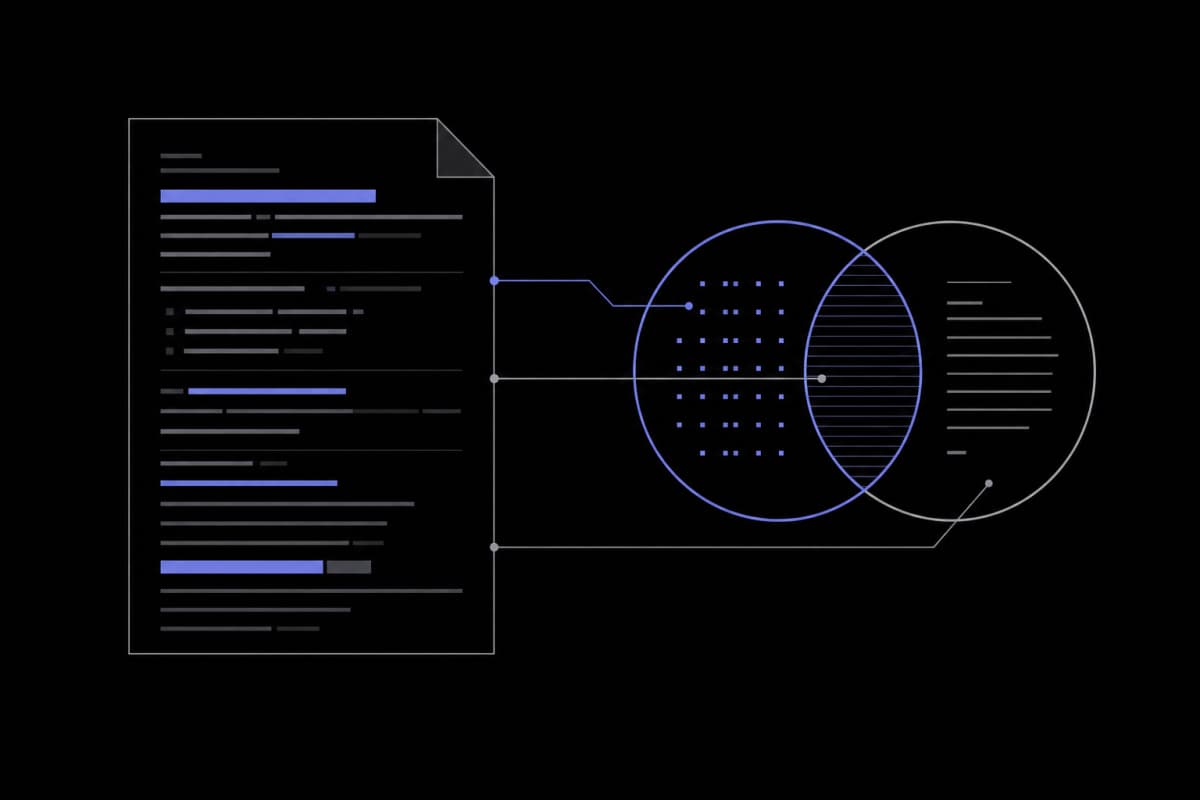
AI detectors and plagiarism checkers answer different questions. Confusing them leads to wrong conclusions. Here's how each works and when to use them.
AI detection and plagiarism detection are not the same tool, and using one in place of the other leads to the wrong conclusion. Plagiarism checkers ask: does this text match something already published? AI detectors ask: does this text show statistical patterns typical of machine-generated writing? Neither gives you a definitive verdict on authorship or misconduct — they give you signals worth investigating. The right workflow uses both together, alongside human judgment, before any decision is made.
Two Tools That Get Confused But Answer Different Questions
The core difference between AI detection and plagiarism detection comes down to what question each tool is actually trying to answer. Plagiarism detection asks: is this text copied from somewhere? AI detection asks: does this text look like it was generated by a language model? They measure completely different things, and treating one as a substitute for the other causes real problems.
Picture a content manager reviewing a batch of freelance submissions, or an instructor grading a set of essays. Both will likely encounter AI detection and plagiarism detection mentioned together — sometimes as if they're the same thing. That's understandable. Both tools orbit the same broad concern: is this writing genuinely original? But they diverge sharply once you move past that surface-level framing.
Here's the distinction that matters. Plagiarism is about source overlap: did this person copy or closely reproduce text that already exists somewhere? AI detection is about authorship pattern estimation: does this text carry the statistical fingerprints of a language model rather than a human writer? A piece of text could score clean on one and raise flags on the other. It could score badly on both for entirely different reasons — or score badly on both when the writing is completely original and entirely human.
This matters because the stakes behind each question are different. A plagiarism flag has a clear evidentiary path: you can pull up the source, compare passages, and evaluate the degree of overlap. An AI detection flag has no equivalent. There's no source document to compare against — only a probability score based on statistical patterns in the text itself.
These tools aren't just different versions of the same instrument. They operate on different architectures, draw on different data, and produce outputs that mean different things. Conflating them leads to unfair accusations, missed problems, and poor editorial decisions.
Plagiarism detection checks whether text was copied from existing sources. AI detection estimates whether text was generated by a machine. These are different questions with different evidence standards — and neither replaces the other.
How Plagiarism Detection Actually Works
Plagiarism checkers work by comparing your text against a database of existing content — published web pages, academic papers, stored documents, and sometimes proprietary repositories. When they find passages that closely match a known source, they flag the overlap and link back to the original. The core question is always about textual similarity to something that already exists.
The mechanics behind a plagiarism checker are more sophisticated than simple copy-paste detection, but the underlying logic is consistent: find text that already exists elsewhere and measure the degree of match.
Most tools use a combination of approaches. String matching looks for exact or near-exact sequences of words shared between your text and a source. Fingerprinting breaks text into overlapping chunks and creates hash signatures for each, allowing quick comparison across massive databases without processing every word individually. Semantic similarity analysis, found in more advanced tools, tries to catch paraphrased content by looking for meaning overlap rather than surface word overlap.
The database matters enormously. Turnitin, for example, maintains a large repository of academic papers and previously submitted student work alongside general web content. A plagiarism checker that only crawls public web pages will miss content from paywalled journals, private submissions, or licensed content databases. A clean result, in other words, doesn't necessarily mean the text is original — it may simply mean the source isn't in the database being checked.
One common mistake is treating a low similarity score as proof of originality. It isn't. It means: we found no significant match in the sources we checked. That's a meaningful signal, but it has limits. Heavily paraphrased content, translated material, and text synthesized from multiple sources can all pass a plagiarism check even when the intellectual work isn't original in any meaningful sense.
Can plagiarism checkers catch AI-generated text?
Occasionally, yes — but only by accident. If an AI model reproduces a passage that closely mirrors a training source, a plagiarism checker might flag that overlap. But AI-generated text is typically assembled from patterns rather than lifted from specific documents, so it usually passes plagiarism checks cleanly. A clean plagiarism score on AI-generated text tells you nothing about whether a human wrote it.
How AI Content Detection Actually Works
AI content detectors analyze statistical patterns in text — primarily perplexity (how predictable the word choices are) and burstiness (how much sentence complexity varies) — to estimate the probability that a language model produced the text. They don't compare text against a database of known AI outputs; they measure how the text itself behaves statistically. This makes them probabilistic tools, not identification instruments.
Understanding what an AI content detector actually measures helps explain why its output requires careful interpretation.
Perplexity is a measure of how surprising each word choice is given what came before it. Language models are trained to predict the most likely next token, which means their output tends toward lower perplexity — more predictable sequences of words. Human writing, especially expressive or creative writing, tends to make unexpected choices. A high perplexity score can suggest a human writer; a low one can suggest a model.
Burstiness measures variation in sentence structure and length. Human writers naturally mix short punchy sentences with longer, more complex ones. They pause, shift register, break rhythm. Models tend to produce more uniform sentence patterns, even when the content varies — and low burstiness is a potential signal of machine generation.
Beyond these two core signals, detectors also look at stylistic consistency, repetition patterns, and the statistical regularity of vocabulary choices. GPTZero describes its approach in terms of perplexity, burstiness, and style. ZeroGPT's model adds a multi-stage deep-learning analysis trained on a mix of internet, educational, and synthetic datasets.
What none of these tools do is identify a specific source model or verify authorship. They output a probability estimate — something like a percentage likelihood of AI generation. That number reflects statistical pattern matching, not forensic analysis. It can't tell you which model generated the text, how much of the text was AI-assisted versus fully AI-generated, or whether a human substantially revised an AI draft.
Does the model family matter for detection accuracy?
Yes, and this is an active challenge for the field. Many detectors were trained primarily on ChatGPT-style output and may perform differently on text from Gemini, Claude, DeepSeek, or Grok. Several platforms, including GPTZero and ZeroGPT, have updated their models to cover a broader range of model families, but coverage gaps remain. This is one reason vendor messaging has shifted in recent years away from certainty claims and toward probability framing.
AI detectors measure statistical patterns like perplexity and burstiness — they estimate probability, not identity. A high AI score doesn't prove a machine wrote the text, and a low score doesn't prove a human did.
Where the Two Overlap (and Where They Don't)
The two tools share one narrow zone of overlap: if AI-generated text happens to reproduce a passage closely matching a known source, a plagiarism checker may flag it. Outside that coincidence, the tools operate in entirely separate domains. Plagiarism detection can't identify AI authorship, and AI detection can't identify source copying. They're not interchangeable in either direction.
A side-by-side comparison makes the boundaries concrete:
| Content Type | Plagiarism Checker | AI Content Detector |
|---|---|---|
| Directly copied text from a known source | Likely to flag (if source is in the database) | Won't flag unless text also shows AI-typical patterns |
| Paraphrased text from a source | May flag if similarity is high; misses heavy rewrites | Won't flag — paraphrasing technique has no bearing on AI score |
| AI-generated text with no source overlap | Usually passes clean | Likely to flag if patterns are consistent with model output |
| AI-generated text that closely mirrors a training source | May flag the overlapping passage | Likely to flag — AI patterns still present |
| Human-edited AI draft (substantial revision) | Passes unless source overlap exists | Scores may decrease with heavy human revision; results vary by tool |
| Original human writing, polished and formal | Passes (no source overlap) | May flag incorrectly — this is the false positive problem |
| Original human writing, conversational or informal | Passes | Generally passes; higher variation tends to read as human |
The row worth pausing on is "original human writing, polished and formal." This is where the two tools diverge in the most consequential way. A plagiarism checker will pass this content correctly. An AI detector may flag it incorrectly — because formal, precise writing can share the same low-perplexity, low-burstiness characteristics that models produce. A well-structured legal brief, a carefully edited academic paragraph, or a technical specification written in plain English can all trigger AI detection warnings even when they were written entirely by humans.
This isn't a theoretical edge case. It's a documented pattern with real consequences for students, non-native English writers, and professional technical writers — all of whom may produce text that reads as statistically "smooth" without any AI involvement.
Why Neither Tool Is a Verdict
Both plagiarism checkers and AI detectors produce signals that require human interpretation — not conclusions that stand on their own. Plagiarism checkers miss sources outside their database coverage. AI detectors produce false positives on human writing and false negatives on revised AI text. Neither tool provides the kind of evidence that supports a definitive accusation or disciplinary action.
This point gets glossed over on most vendor pages, so it's worth being direct about it.
On the AI detection side, false positives are a documented problem across the field. Academic technology guidance from multiple universities explicitly warns against relying on detector output as sole evidence in misconduct cases. In published testing, tools including ZeroGPT and Originality.ai have flagged entirely human-written passages with high confidence scores — demonstrating that a tool's stated certainty and its actual accuracy can diverge significantly.
Non-native English writers face a particular fairness risk here, and it's measurable. A 2023 Stanford study (Liang et al., published in the journal Patterns) found that GPT detectors misclassified more than half of TOEFL essays written by non-native English speakers as AI-generated, while classifying essays by native speakers almost perfectly. The reason ties back to perplexity: writers who use simpler, more regular sentence patterns — whether because of language background, writing style, or genre conventions — are far more likely to have their human-written work misidentified. That's not a minor technical footnote. It's a genuine equity issue in any context where AI detection scores carry consequences.
Plagiarism checkers have their own limitation: database coverage. A text can pass every plagiarism check available and still be substantially derived from a source the tool never indexed. Private documents, unpublished manuscripts, licensed databases, and content behind paywalls are all invisible to most checkers. A clean result means "no match found," not "this is original."
Originality.ai states plainly on their own product page that AI scores reflect probability, not guilt. That framing applies to both tool types. Detection software should be only one input within a broader examination of the evidence — never the final word.
False positives are real, database gaps are real, and no detector produces a verdict. Use these tools to identify signals worth investigating — not to close a case.
Which Tool to Use for Which Decision
The right tool depends on what question actually matters for your decision. Academic submission review primarily needs source-matching evidence; editorial quality review primarily needs authorship pattern signals; brand compliance work often needs both. Matching the tool to the actual concern prevents both missed problems and unfair accusations.
Rather than treating AI detection and plagiarism detection as interchangeable, it helps to map each signal to the decision it actually informs. The Signal-to-Use-Case Map below makes that mapping explicit:
| Use Case | Primary Concern | Lead Tool | Supporting Tool |
|---|---|---|---|
| Academic submission review | Source copying, contract cheating | Plagiarism checker | AI detector (as a flag, not verdict) — any result needs faculty review |
| Editorial content review (blog, media) | Authenticity, voice, factual grounding | AI detector | Plagiarism checker for factual claims — editorial judgment on tone and accuracy is essential |
| Freelance writer hiring / vetting | Whether human expertise was applied | AI detector (screening stage) | Plagiarism checker for portfolio samples — a direct conversation often clarifies more than a score |
| Brand content compliance | Policy adherence, disclosure requirements | Both tools, plus internal policy review | Tone and style review — policy definitions vary by organization |
| SEO content at scale | Duplicate content, thin content | Plagiarism checker (inter-site duplication) | AI detector if quality standards require disclosure — spot-check sample review recommended |
A few things stand out from this framework. There is no use case where AI detection alone is sufficient. Even in editorial contexts where AI authorship is the core concern, a plagiarism check adds value by catching source overlap that an AI detector can't see.
Human review is essential in the majority of use cases. This reflects the false positive and database-gap problems discussed above — the tools narrow your focus, but they don't make the call.
The freelance hiring row is worth a closer look. An AI detection score on a writing sample tells you the text shows patterns associated with machine generation. It doesn't tell you whether the writer used AI as a drafting tool, a research aid, or not at all. Many skilled freelancers use AI responsibly and produce excellent work. The score is a prompt for a conversation, not a hiring decision.
What about tools that combine both functions?
Several platforms now bundle AI detection and plagiarism checking into a single interface — Originality.ai is the clearest example, and others are moving in that direction. Bundling is convenient, but it doesn't change the underlying distinction. A combined score still comes from two separate analyses answering two separate questions. Treat them separately even when the interface presents them together.
A Responsible Workflow When Both Signals Raise Flags
When both a plagiarism check and an AI detection score raise concerns about the same piece of writing, the right response is to gather more context before drawing any conclusions. A flag from either tool is a reason to look more carefully, not a reason to act. The workflow below gives you a structured way to do that.
Say you receive a piece of writing — a student assignment, a commissioned article, a freelancer's draft — and both tools flag it. Here is a step-by-step approach:
- Step 1: Document the specific signals, not just the scores. Note which passages the plagiarism checker flagged and what sources it matched. Note the AI detection score and, if the tool provides it, which sections of the text drove the score highest. A high AI probability score spread evenly across a document is a different signal than one section peaking while the rest reads as human.
- Step 2: Check the matched sources in the plagiarism report yourself. Pull up the flagged sources. Is the overlap a verbatim sentence, a paraphrased idea, or a common phrase any writer might use? "The results showed a statistically significant difference" isn't plagiarism even if it matches a hundred papers. A copied argument with only words swapped is a different matter entirely.
- Step 3: Read the writing as a human reader. Does the voice shift mid-document? Are there abrupt changes in complexity, vocabulary, or register that might suggest different authorship across sections? Does it answer the actual brief in a way that reflects specific knowledge, or does it feel generic? These are observations that no tool replicates.
- Step 4: Use the signals to prompt a direct conversation. For a student: "I noticed some passages in your essay scored high on our AI detection tool and overlapped with some sources. Can you walk me through how you approached the research and drafting for this section?" For a freelancer: "We run AI and plagiarism checks as part of our editorial process. This draft flagged in a couple of spots — can you tell me more about your research and writing process for this piece?"
- Step 5: Evaluate the conversation alongside the signals. A writer who wrote the piece should be able to speak to their sources, explain their choices, and expand on the ideas in the text. A vague or deflecting response is more meaningful evidence than the tool score itself. A specific, coherent account of the writing process shifts the evidentiary picture considerably.
- Step 6: Apply your organization's actual policy. Many organizations distinguish between "AI-generated," "AI-assisted," and "AI-edited" content — and your policy may allow some but not others. Before any consequential decision, confirm which category the evidence points toward and whether that category is addressed by your policy.
The broader principle: detection tools are screening instruments. They tell you where to look more carefully. The decision itself belongs to a human who understands context, policy, and the difference between a statistical signal and a conclusion.
For a related discussion of how human review catches what automated tools miss, see our piece on Revision vs. Editing vs. Proofreading.
Frequently Asked Questions
Is ChatGPT-generated content considered plagiarism?
Not automatically. Plagiarism requires that text be copied or substantially reproduced from an existing source without attribution. AI-generated text is assembled from statistical patterns rather than lifted from specific documents, so it is usually not plagiarism in the traditional sense. The more relevant question for most organizations isn't plagiarism but policy compliance — whether AI use is disclosed, permitted, or appropriate for the context. Some institutions treat undisclosed AI use as a form of academic dishonesty under their own policies, independent of whether plagiarism in the strict sense occurred.
Can AI detectors flag human writing as AI-generated?
Yes, and this is well documented. Formal, precise, or highly polished human writing tends to share the low-perplexity and low-burstiness patterns that language models also produce, which increases the risk of false positives. Non-native English writers are particularly vulnerable: simpler, more regular sentence patterns — used for clarity, not deception — can push scores toward AI-flagged territory. This is why no responsible policy treats a detection score as conclusive evidence on its own.
Should I use both tools before publishing content?
For editorial quality control, running both checks is a reasonable practice — but understand what each one tells you. The plagiarism check identifies source overlap you should address. The AI detection score flags statistical patterns that may warrant a closer read or a conversation with the writer. Neither score alone is sufficient grounds for a publishing or rejection decision; both are inputs to human editorial judgment. The combination is more useful than either tool alone, precisely because they answer different questions.
How do AI detection scores change when a human edits an AI draft?
Substantially, in most cases — but the degree depends on how deeply the text is revised. Light edits (fixing grammar, swapping a few words) typically leave the underlying statistical patterns intact, and scores remain high. Heavy revision that restructures sentences, varies rhythm, and introduces specific detail tends to reduce AI scores meaningfully. This is also why AI detection scores cannot reliably distinguish between "fully AI-generated" and "AI-drafted, heavily revised by a human" — a limitation worth understanding before acting on any score.
What is the best approach when a plagiarism checker and an AI detector give conflicting results?
Conflicting results are actually informative. If a plagiarism checker flags source overlap but the AI detector scores low, the concern is likely traditional plagiarism — a human copying a source — and the plagiarism evidence is the one to investigate. If the AI detector flags high but the plagiarism checker is clean, the concern is authorship pattern, not source copying; the appropriate response is a conversation with the writer, not a source-comparison exercise. Read each result for what it actually measures rather than trying to reconcile them into a single verdict.
Do AI detectors work equally well across different AI models?
No, and this is an active limitation. Many detectors were trained primarily on output from earlier ChatGPT versions and may perform less reliably on text from Gemini, Claude, DeepSeek, Grok, or other model families. Vendors including GPTZero and ZeroGPT have expanded their training data to cover more models, but coverage gaps remain. If your context involves a specific model family, it is worth checking whether the detector you're using has documented performance data for that model — vendor documentation and independent evaluations are the most reliable sources for this.
This article was drafted with AI assistance, fact-checked against primary sources, and reviewed by our editorial team before publishing. How we use AI.