

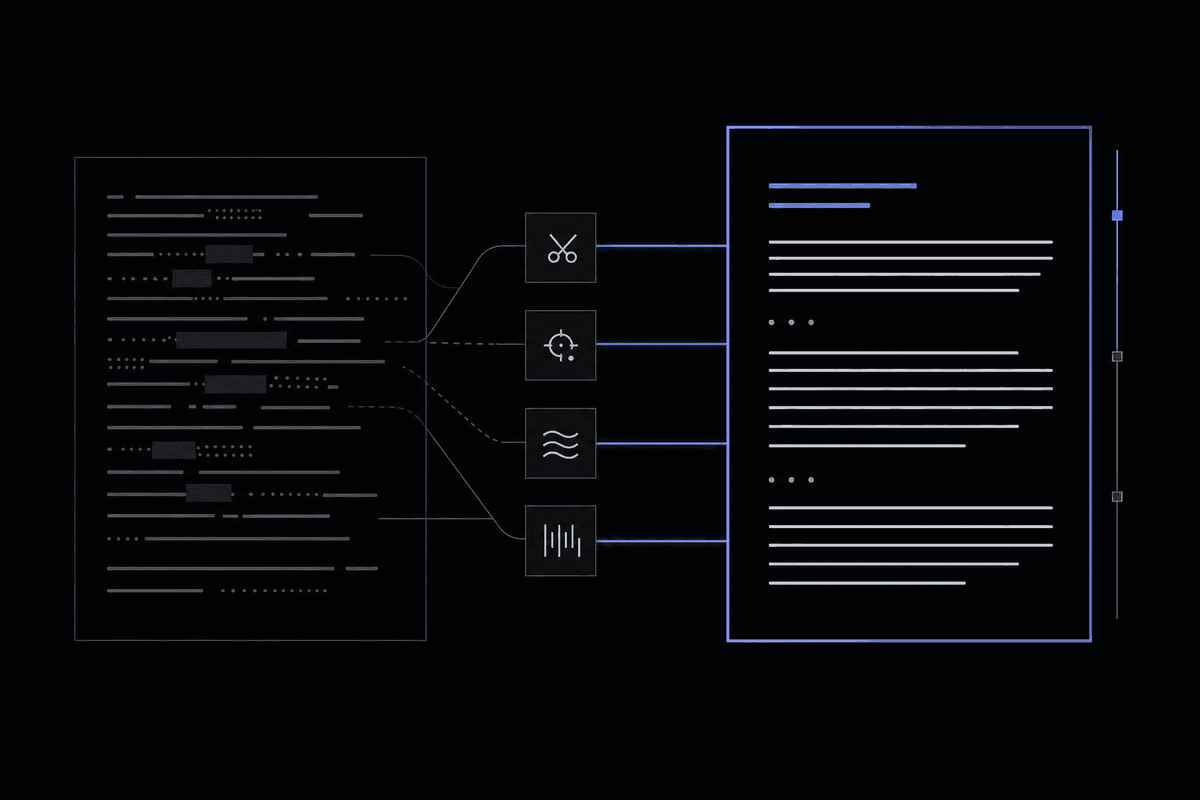
AI drafts carry nine structural fingerprints that prompting can't fix. This 4-pass editing workflow shows you how to humanize AI text for good.
AI-generated drafts carry nine structural and stylistic fingerprints — hedging phrases, tricolon overuse, hollow em-dash asides, and more — that prompting alone can't remove. This guide walks through a four-pass editing workflow: cut stock phrases, break rhythm patterns, inject details only you can supply, and restructure for narrative pull. AI detectors are useful as directional signals during editing, not as final verdicts on quality or originality.
The 9 Tells That Mark a Draft as AI-Written
AI-written drafts share nine recurring patterns — from hedge-phrase overload and tricolon sentence structures to hollow transitions and predictable list formatting. Recognizing these patterns before you edit is what separates a 20-minute fix from a piece that still reads like a chatbot wrote it.
The first skill in editing AI output is diagnosis. You can't edit what you can't see. After running outputs through recent large language models and marking up the results like a copy editor with a red pen, these are the nine patterns that show up most consistently.
1. The Hedge Stack
AI models are trained to avoid being wrong, so they qualify constantly. A single paragraph might contain "it's important to note," "generally speaking," "in many cases," and "it can be argued" — sometimes all four. Each phrase sounds cautious in isolation. Together, they drain the paragraph of any actual stance.
2. Tricolon Overuse
Three-part lists are rhetorically satisfying, which is probably why AI defaults to them so relentlessly. "Clear, concise, and compelling." "Fast, reliable, and accurate." One tricolon in an article is fine. Six is a tell. Real writers mix one-item emphasis, two-item contrast, and the occasional four-item pile-up.
3. The Em-Dash Aside
Current models love dropping a parenthetical aside with em-dashes to signal nuance. "This approach — while not perfect — tends to work well." The construction itself isn't the problem; it's the frequency. If you see one em-dash aside every two or three paragraphs, count them. More than two per page is a flag.
4. Hollow Transitions
Phrases like "building on that," "with that in mind," and "it's worth considering" create the appearance of logical flow without actually connecting ideas. They're connective tissue with nothing to connect. Human writers either use a hard break or show the logical link explicitly.
5. The Balanced Sentence Cadence
Run an AI draft through a readability tool and check sentence lengths. You'll often find a cluster of sentences between 18 and 24 words, back to back, paragraph after paragraph. It reads smoothly but feels oddly even — like music recorded to a click track with no swing.
6. Predictable List Structure
Every section gets a bulleted list with three to five items. Every item starts with a bold word followed by a colon. Every explanation runs roughly the same length. Real writers use lists when items are genuinely parallel and enumerable — not as a default formatting reflex.
7. The Safe-Opinion Dodge
Ask an AI for its take on a contested topic and it'll often give you both sides, balanced symmetrically, ending with "ultimately, it depends on your specific situation." That's not an opinion. Humans have opinions. They say one approach is better and explain why.
8. Generic Opener + Summary Close
Most AI drafts open with a definition or broad context statement and close with a section that begins "in summary" and recaps every preceding point. Neither move is wrong on its own, but together they form a predictable frame that signals the piece was generated rather than written.
9. Adjective Inflation
AI reaches for adjectives when concrete nouns would do more work. "Comprehensive solution," "robust framework," "powerful methodology" — these pile up because the model is pattern-matching to writing that sounds impressive, not to writing that communicates precisely. Strip the adjectives and ask whether the noun alone carries the meaning.
The nine AI tells are mostly structural habits, not vocabulary problems. Spotting them before you start editing turns a vague "this sounds off" feeling into a specific checklist you can work through systematically.
Why Prompting Alone Won't Fix the Problem
Even a carefully engineered prompt reduces AI tells — it doesn't eliminate them. The model's underlying output distribution still defaults to its training patterns when generating at scale, which means structural fingerprints survive even when tone and vocabulary improve. Only line-level editing removes them reliably.
This is the part nobody likes to hear after spending an hour refining their system prompt. Prompting is genuinely useful for direction-setting: you can steer the model toward a particular tone, specify the audience, request shorter paragraphs, or ask it to avoid certain phrases. That work isn't wasted.
Here's the thing, though. Prompting changes what the model tries to do; it doesn't change what the model is. The training patterns are still there. Tell the model to "write conversationally and avoid hedging," and it'll write something more conversational — but the tricolon overuse will likely remain. Tell it to "write like a senior editor at a trade magazine," and the hedge stack gets smaller, but the predictable list structure often survives intact.
A concrete example
Take this prompt: "Write a 200-word paragraph about why freelance writers should track their editing time. Write in a direct, opinionated voice. No bullet points. No hedging."
A representative model output (condensed for illustration): "Tracking your editing time is one of the most valuable habits a freelance writer can develop. When you understand how long revision actually takes — often longer than the initial draft — you can price your work accurately and avoid undercharging. This simple practice, while often overlooked, can transform how you approach project scoping. By recording your time consistently, you gain the data you need to make confident decisions about rates and deadlines."
Count the tells: one em-dash aside, one "while often overlooked" hedge, the phrase "transform how you approach" (adjective inflation in verb form), and a closing sentence that essentially restates the opening. The prompt worked — there are no bullets, the tone is more direct. But the fingerprints are still there, distributed across the paragraph like bad habits that survived a talking-to.
What most people miss is that the model is still optimizing for text that looks like good writing rather than text that is good writing. Those are related but different targets. Editing bridges the gap because it's a human judgment about whether the writing is actually working — a judgment the model can't reliably make about its own output.
Prompting and editing aren't competing strategies. Think of prompting as narrowing the starting point and editing as finishing the job. A well-prompted draft takes less editing time. It just isn't a substitute for editing.
Treat prompting as draft-quality control, not as a replacement for editing. The structural fingerprints that make AI text identifiable survive even strong prompts — and only pass-by-pass editing removes them.
Pass 1: Cut the Hedges and Stock Phrases
The first editing pass is a search-and-destroy mission for qualifying phrases and clichéd transitions that add word count without adding meaning. Most AI drafts can be cut substantially in this pass alone, and the writing immediately gains authority.
Open the draft and do this pass before touching anything else. Structural changes are harder when you're working around filler. Use your word processor's find function to locate these phrases quickly. Then decide: delete or rewrite. If you'd rather start from an automated pass, our AI Humanizer runs many of these rewrites and previews a detector score — then you refine the result by hand with the passes here, which is what gives the writing your actual voice.
| AI Stock Phrase | What to Do | Rewritten Example |
|---|---|---|
| "It's important to note that" | Delete entirely | Just state the fact directly |
| "In today's fast-paced world" | Delete entirely | Start with the actual claim |
| "It can be argued that" | Replace with a direct assertion | "The evidence suggests..." or just make the claim |
| "With that in mind" | Delete or show the actual connection | Rewrite the sentence to explain why it follows |
| "At the end of the day" | Delete entirely | State the conclusion plainly |
| "This is particularly true when" | Replace with specific condition | "If you're writing for a B2B audience specifically..." |
| "It's worth noting" | Delete entirely | Just note the thing |
| "Generally speaking" | Delete or qualify specifically | "For most solo freelancers..." (actual scope) |
Before and after: a worked example
Before (AI draft): "It's important to note that content marketing, while a powerful strategy, requires consistent effort over time. Generally speaking, brands that prioritize quality over quantity tend to see better results. With that in mind, it can be argued that your editorial calendar should reflect your team's actual capacity."
After (edited): "Content marketing requires consistent effort — and most brands underestimate how long it takes to see traction. Quality beats volume, which means your editorial calendar should reflect what your team can actually sustain, not what sounds ambitious in a planning meeting."
The edited version is shorter, takes a real stance, and includes a specific tension (planning vs. reality) that makes the advice concrete. Three hedge phrases were deleted. One tricolon became a more specific two-part observation.
A common mistake here is replacing one hedge with another. "It's important to note" becomes "keep in mind" — still a hedge, just a different one. The goal is to eliminate the qualified preamble entirely and lead with the claim.
Pass 2: Break the Rhythm Pattern
AI prose tends to run at a metronomic sentence length that reads smoothly in isolation but feels oddly flat over several paragraphs. Breaking this pattern means deliberately introducing fragments, longer compound sentences, and the occasional parenthetical aside — placed by human choice, not by statistical frequency.
Read your edited draft aloud. If every sentence takes roughly the same breath, that's the tell. Human writers unconsciously vary cadence because they're thinking through ideas at different speeds — a sharp insight gets a short sentence, a nuanced explanation needs a longer one, and sometimes a single word earns its own line.
Three techniques that actually work
Introduce fragments intentionally. Not every sentence needs a subject and a predicate. "Simple as that." "Three passes. Maybe four." Fragments land harder than qualified clauses because they leave no room to hedge. The key word is intentionally — a fragment should punch, not just cut off mid-thought.
Build one genuinely long sentence per section. AI sentences of 20-something words feel long because they're uniform, but a skilled writer can run 40 words with a subordinate clause or two and a reader will follow it fine, provided the logic is clear and there's a payoff at the end. The length signals effort and complexity in a way that clusters of medium sentences don't.
Add an aside in parentheses (not em-dashes). This is partly cosmetic — parentheses read as a human interjection, while em-dashes at AI frequency read as a model pattern. But it's also structural: parenthetical asides let you acknowledge a complication without derailing the main sentence, which is something humans do in real conversation all the time.
What about readability scores?
Readability guidance for web content consistently recommends keeping average sentence lengths short for online reading. But "average" is doing a lot of work in that guidance. A low average achieved by writing every sentence at exactly the same length is worse than a slightly higher average achieved by mixing short punches with longer explanations. Rhythm comes from variance, not from low averages. The Readability Checker at Tools for Writing highlights long sentences individually, which makes it easier to see where to cut — but don't chase a score at the expense of natural cadence.
One common mistake in this pass is over-fragmenting. When every paragraph becomes two sentences and a fragment, it starts to read like a listicle from 2014. Use fragments sparingly.
Pass 3: Add Specificity AI Can't Generate
The most reliable way to make AI writing sound human is to inject information the model cannot invent: your actual numbers, your named clients (with permission), specific dates, personal opinions stated plainly, and anecdotes from your own experience. These details are also what makes content genuinely useful rather than generically correct.
AI can produce accurate generalities. It can't tell your story. This pass is where you stop editing someone else's draft and start writing your own piece — using the AI output as scaffolding rather than as the building itself.
What to add and where
Named numbers with context. "Results varied" becomes "our open rate dropped from 31% to 22% in three weeks." The number doesn't have to be impressive — it has to be real. Real numbers are specific in ways that round numbers never are.
Dated references. "We tried this approach in March 2025 when our team was switching from weekly to biweekly publishing" tells a reader exactly when, which makes the experience checkable and grounded. AI output exists in a vague eternal present.
Opinions stated without hedging. Not "many experts suggest that shorter subject lines tend to perform better." Just: "Subject lines over eight words tank open rates in our newsletter list. Keep them short." That's a stance. Readers trust writers who have stances.
Names (when appropriate). "A colleague suggested" is AI-flavored. "Our senior editor pointed out during a content review" is human-flavored even without a name attached — the specificity of the context makes it feel real.
Before and after
Before: "Adding personal anecdotes to your content can significantly improve reader engagement and help establish trust with your audience."
After: "The post that drove the most newsletter signups we've ever had wasn't our most researched piece. It was a short story about an editing mistake that cost a client a product launch. People forwarded it. Anecdotes travel in ways that advice doesn't."
The after version takes a position (anecdotes outperform advice in shareability) and gives a concrete outcome (forwarding behavior). Neither came from the AI draft.
Passes 1 through 3 follow a clear sequence: remove what weakens the draft, vary what makes it monotonous, then add what makes it irreplaceable. None of these passes require scrapping the AI output — they require you to own it.
Pass 4: Reorder for Human Logic
AI drafts nearly always lead with context, then explanation, then insight — because that's the pattern most common in training data. Human writers often do the opposite: lead with the tension or the insight, then explain how they got there. Restructuring for narrative pull usually means moving your strongest sentence from paragraph four to paragraph one.
This is the pass most guides skip because it's the hardest to systematize. There's no find-and-replace for narrative logic. It's also where the biggest gains happen, because restructuring changes how a reader experiences the piece rather than just how a sentence sounds.
The AI default structure (and why it falls flat)
A typical AI-generated section looks like this:
- Opening sentence that defines or contextualizes the topic
- Two or three supporting sentences building toward a point
- The actual point, buried mid-paragraph or at the end
- A summary sentence that restates the opening
This is a perfectly logical structure. It's also the structure of a briefing document, not a piece of writing that makes someone want to keep reading. The payoff arrives after the reader has already decided whether to continue.
How to restructure for pull
Find the most interesting sentence in the section. Drag it to the top. Then ask whether the sentences that preceded it are still necessary — often they aren't, because an interesting opening makes readers willing to follow the logic without the preamble.
Before (AI structure): "Content strategy is a broad discipline that encompasses everything from audience research to distribution planning. Many organizations struggle to implement it consistently, especially without dedicated resources. One approach that often helps is starting with a single content format and expanding from there. This reduces the complexity of early decisions and allows teams to build sustainable habits."
After (restructured): "Start with one content format and publish it consistently for 90 days before adding anything else. Most content strategies collapse not from bad ideas but from too many formats started and abandoned. The research, the distribution planning, the audience work — all of that is easier once you have one thing actually working."
The restructured version leads with the specific recommendation, explains the actual problem (overexpansion), then gestures toward the broader context. The reader gets the point immediately, and the rest earns its place by answering "why."
When AI structure is actually fine
Procedural content — how-to steps, technical documentation, reference guides — often benefits from the logical, context-first structure AI defaults to. Don't restructure for narrative pull when the reader's goal is to execute a process rather than be persuaded or engaged. Match the structure to the reader's intent.
Testing the Result Against a Detector — What It Can and Can't Tell You
AI content detectors are directional tools, not verdicts. They identify statistical patterns associated with model-generated text, but they can't confirm whether a piece is genuinely original, high-quality, or deceptive. Use them to locate which paragraphs still read as formulaic — then edit those paragraphs, not the score.
There's a temptation to run a detector at the end and treat a green result as a sign of success. That's the wrong frame. The goal of editing AI output isn't to fool a detector — it's to produce writing that's genuinely better. A detector score is one proxy for that, and a noisy one.
What detectors actually measure
Most AI detectors calculate the statistical likelihood that a piece of text was generated by a model, based on patterns in vocabulary choice, sentence structure, and prediction confidence (a measure called "perplexity"). Text that uses uncommon word combinations and less predictable sentence structures scores as more "human." Highly predictable text — which, by training, much AI output is — scores as AI-generated.
The problem: predictability correlates with AI output but isn't exclusive to it. Detector research has shown that clear, simple writing — exactly what readability guidance recommends — also trends toward higher predictability scores, and that non-native English writers are disproportionately flagged as false positives. A detector flagging your well-edited piece isn't necessarily catching AI content; it might just be catching plain writing.
Use an AI content detector as a diagnostic mid-edit: note which paragraphs flag as high-probability AI and prioritize those for your specificity and rhythm passes. Then run it again. If scores improve alongside your editorial passes, that's a signal the edits are working. If a section still flags after three passes, read it aloud — you'll almost always hear why.
A practical workflow for using detectors in editing
- Run the detector on the raw draft and note which sections flag highest.
- Apply Passes 1 through 4 to those sections first.
- Run the detector again after editing.
- If specific paragraphs still flag, check for remaining hedge phrases, even sentence cadence, and missing specifics — the tells from section one.
- Use the final score as one data point, not as publication clearance.
The ethics question
Editing AI output to sound human isn't inherently deceptive, and it becomes less so the more substantially you edit. The piece you publish after four careful editing passes — with your numbers, your opinions, your anecdotes, and your structure — is genuinely yours. The AI draft was a starting point, the same way a research brief or a ghostwriter's first pass is a starting point.
Disclosure norms are still evolving. A simple line — "This article was drafted with AI assistance and edited by our team" — tends to maintain trust while being accurate about the process. For editorial and educational content especially, that transparency is worth including.
A detector score is a useful signal during editing, not a publication standard. The real test is whether the finished piece contains information, opinions, and specifics that only you could have contributed — and whether a reader could tell the difference.
Frequently Asked Questions
How do I make my AI text sound human?
Work through the text in four focused passes: first, delete hedging phrases and stock transitions; second, vary sentence length by mixing fragments with longer compound sentences; third, add specific details — numbers, names, dates, opinions — that only you can supply; fourth, move your strongest point to the top of each section rather than burying it mid-paragraph. Reading the draft aloud after each pass will reveal what still sounds formulaic faster than re-reading silently.
What prompt should I give ChatGPT to make it sound human?
Prompting helps narrow the starting point but won't remove structural AI fingerprints on its own. The most effective prompts specify audience, purpose, format, and tone — for example, "Write for a solo freelance copywriter, in a direct opinionated voice, no bullets, vary sentence length" — but expect to edit the output regardless. Treat the prompt as reducing your editing workload, not eliminating it.
What are the most obvious AI writing tells?
The nine most consistent tells from recent model testing are: hedge-phrase stacking, tricolon overuse, frequent em-dash asides, hollow transitional phrases, uniform sentence cadence, predictable bullet-list formatting, safe non-opinions on contested topics, generic opener plus summary close, and adjective inflation on abstract nouns. Style tells (hedges, tricolons) and structural tells (even cadence, predictable framing) are the hardest to fix with prompting alone.
How do AI content detectors work, and should I trust them?
Detectors calculate the statistical predictability of a piece of text — highly predictable text scores as likely AI-generated, while unusual word combinations and sentence structures score as more human. They're useful for identifying which paragraphs still carry heavy formulaic patterns during editing, but false positive rates for plain writing and non-native English writers are well-documented. Use detector scores as one directional signal, not as a final judgment on quality or originality.
Should I disclose that content is AI-assisted?
For editorial, educational, and thought-leadership content, disclosure is the cleaner choice — both ethically and for reader trust. A simple line like "drafted with AI assistance and edited by our team" is accurate and tends to maintain reader confidence without undermining the content's authority.
How do I edit ChatGPT output to match my brand voice?
Start by pulling three to five representative pieces of your existing content and noting the consistent patterns: level of formality, use of contractions, typical sentence length, recurring phrases you use, and topics you express opinions on. Then read the AI draft against those samples and swap words and constructions that don't match. Concrete voice cues — "we say 'use' not 'leverage,' we give verdicts not options, we write in second person" — are more useful during editing than abstract descriptors like "conversational" or "approachable."
Can AI-assisted content rank in Google search?
Google's helpful-content guidance focuses on whether content is original, useful, and written for people rather than for search engines — not on whether AI was involved in drafting it. Heavily edited AI content that includes genuine expertise, specific detail, and a clear point of view tends to perform well because it meets those criteria. Thin, unedited AI output that recycles generic information without adding depth performs poorly over time, regardless of how it was produced.
How long does it actually take to humanize an AI draft?
For a typical 1,000-word blog post, the four-pass workflow described in this guide takes most editors between 45 and 90 minutes when they have their own specific details and opinions ready to add. The specificity pass (Pass 3) takes the longest because it requires genuine contribution — thinking through what you actually know and believe about the topic — rather than just editing existing text. Having a rough voice-memo or set of notes before you start editing cuts that time significantly.
This article was drafted with AI assistance, fact-checked against primary sources, and reviewed by our editorial team before publishing. How we use AI.