

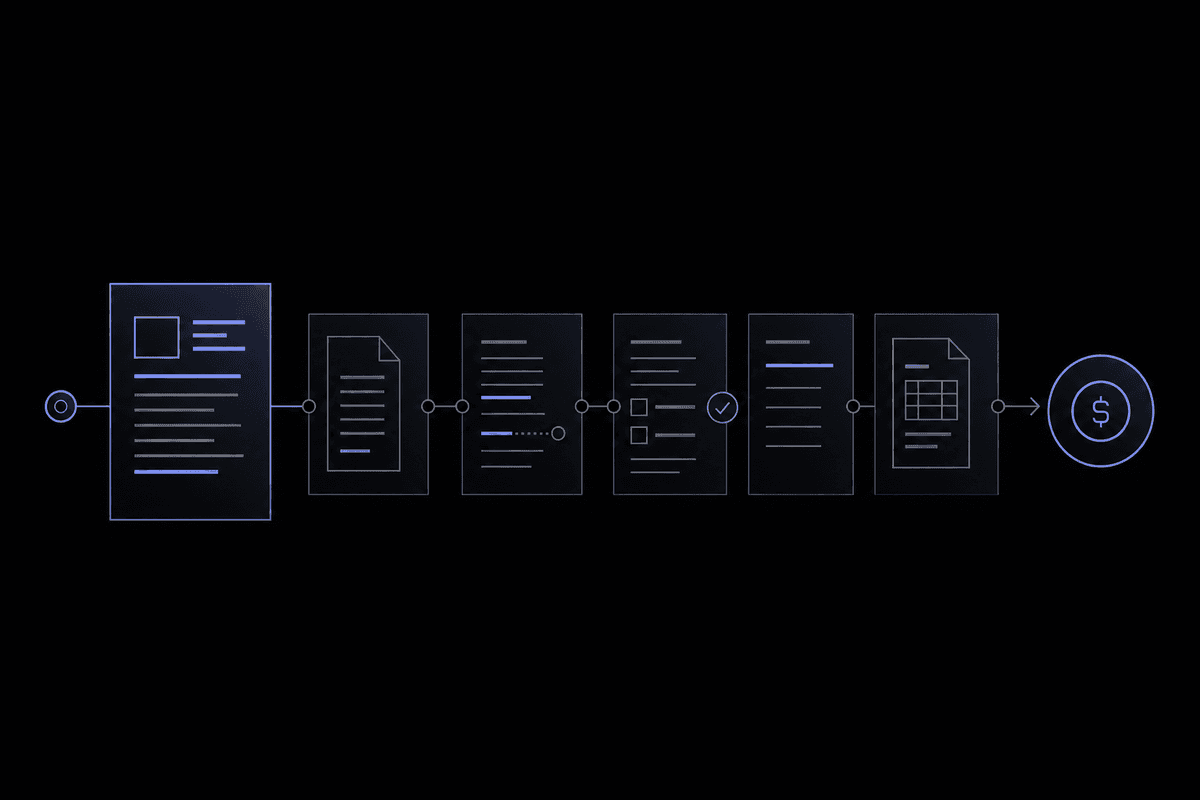
Struggling with late payments, endless revisions, or missed deadlines? This 7-stage freelance writing workflow fixes your process from pitch to payment.
A solid freelance writing workflow covers seven stages: pitch, brief, research, draft, edit, deliver, and invoice. Most writers lose time at the brief and editing stages because they skimp on upfront clarity. Use templated pitches to win clients faster, a detailed briefing checklist to cut guesswork, batched writing sessions to protect focused work time, and a multi-pass editing process to polish every draft before delivery. Agree on payment terms before the project starts — and follow up on late invoices with a calm, specific script.
What Does an Efficient Freelance Writing Workflow Look Like?
An efficient writing workflow for freelancers is a repeatable seven-stage system: pitch, content brief, research and outline, drafting, self-editing, client delivery, and payment. Following the same sequence on every project reduces decision fatigue, shortens turnaround times, and protects you from scope creep and late payments.
Picture this: it's Thursday afternoon, you have two drafts due Friday, a client waiting on a revised brief, and an invoice from three weeks ago that still hasn't been paid. None of that is a talent problem. It's a systems problem — and it's almost universal among writers in their first year or two of freelancing.
Pitching when you remember to, drafting when inspiration strikes, invoicing whenever a project feels "done" — that approach holds up for your first few clients. By client ten, it collapses. The fix isn't working harder. It's building a sequence you can follow without reinventing it each time. As James Clear puts it in Atomic Habits, "You don't rise to the level of your goals. You fall to the level of your systems." Your income ceiling isn't your talent level — it's the quality of your process.
Here is what the seven-stage freelance writing workflow looks like end to end:
- Stage 1 — Pitch: Identify a target client, send a short, tailored pitch, and follow up once.
- Stage 2 — Brief: Run a discovery call or send a questionnaire; document goals, audience, tone, and deliverables in writing.
- Stage 3 — Research and Outline: Block dedicated research time, build a structured outline, and get client sign-off before drafting a single word.
- Stage 4 — Draft: Write in batched, distraction-free sessions tied to your natural energy peaks.
- Stage 5 — Self-Edit: Run a multi-pass edit covering structure, clarity, voice, and mechanics.
- Stage 6 — Deliver: Send in the agreed format with a short summary of what you did and why.
- Stage 7 — Invoice and Follow Up: Send an invoice the same day you deliver, with payment terms already agreed in your contract.
Why does this matter financially? According to Bonsai's 2024 Freelance Industry Report, freelancers spend an average of 20 to 30 percent of their working hours on non-billable administrative tasks — emails, revision chasing, invoicing. A structured workflow reclaims a meaningful chunk of that time and redirects it toward paid output.
One thing most guides skip: capacity planning. Before accepting a new project, you need a rough time budget. A typical 1,500-word blog post takes most experienced writers six to eight hours from brief to final draft. At 30 billable hours a week, that's three or four articles at that length — with buffer for client communication. Knowing this prevents overpromising, and the frantic, quality-killing scramble that follows.
There's another dimension people tend to underestimate: the client experience built into the workflow itself. Clients who feel well-managed and well-communicated with become repeat clients. A study by the Edelman Trust Institute found that trust built through consistent, reliable delivery is the single biggest driver of long-term client relationships in service businesses. Your workflow isn't just a productivity tool — it's your retention strategy.
| Workflow Stage | Typical Time (1,500-word article) | Common Bottleneck |
|---|---|---|
| Pitch and Discovery | 30–60 minutes | Chasing unresponsive clients |
| Brief and Scope | 30–45 minutes | Vague or missing client input |
| Research and Outline | 1–2 hours | Rabbit-hole research with no structure |
| Drafting | 2–3 hours | Context switching and interruptions |
| Self-Editing | 1–1.5 hours | Skipping passes under deadline pressure |
| Delivery and Formatting | 20–30 minutes | Wrong format, missing metadata |
| Invoicing and Follow-up | 10–15 minutes | Delayed sending, unclear payment terms |
A seven-stage workflow isn't bureaucracy — it's the fastest path from pitch to payment. Map your current process against these stages and identify where projects stall most often. That's your highest-leverage fix.
How Do You Pitch and Win Freelance Writing Clients?
Winning freelance writing clients consistently comes down to a short, specific pitch focused on a benefit to the client rather than your credentials, paired with a single well-timed follow-up. Cold email outreach works best when you target one niche, reference something specific about the publication or brand, and link to two or three relevant portfolio samples rather than a general landing page.
Here's the uncomfortable truth about pitching: most freelancers write pitches that are fundamentally about themselves. "I'm an experienced writer with five years of B2B experience and a passion for technology." Clients don't care. They're scanning dozens of emails looking for one thing: can you solve a problem I have right now?
A pitch that converts has three components:
- A specific hook: Reference something real about their business. "I noticed your blog hasn't published in six weeks — I write SaaS comparison articles that typically rank on page one within 90 days."
- Proof of concept: Link to one or two pieces that are as close as possible to what they need, not your best writing in general.
- A low-friction call to action: Ask for a 20-minute call or offer to send a short sample outline — not a "let me know if you want to work together" non-question.
Here is a cold email framework that consistently performs well:
Subject: [Their company] — one content idea that's working for [competitor]
Hi [Name], I came across [specific article or product page] and noticed you're publishing in [topic area]. I write long-form content for [similar companies] — here's one piece that drove [specific result]: [link]. Would a 20-minute call this week make sense? I have two or three ideas specific to your audience.
Keep the whole thing under 100 words. Editors and content managers read dozens of these. Brevity signals confidence.
According to a 2025 HubSpot email benchmark report, follow-up emails sent three to five business days after an initial pitch have a 40 percent higher response rate than pitches with no follow-up. Send exactly one follow-up. Two starts to feel like pressure. Zero leaves money on the table.
Your follow-up can be even shorter: "Hi [Name], just bumping this up in case it got buried. Happy to share a quick sample outline if that would help." That's it.
A common mistake at this stage is pitching too broadly. Sending the same generic email to 50 publications across 10 different industries rarely converts. A focused list of 15 highly targeted prospects in a single niche almost always outperforms it — specificity signals that you actually understand the client's world.
What about inbound leads?
Inbound leads from your portfolio site, LinkedIn, or referrals require a slightly different response. Speed matters enormously here. Research from InsideSales.com shows that responding to an inbound inquiry within five minutes makes you 21 times more likely to qualify that lead than responding within 30 minutes. When an inbound lead arrives, your first goal is to schedule a discovery call within 24 hours — not to immediately quote a price. Rushing to a number before you understand the scope is one of the most common and costly mistakes in the freelance writing process.
For writers looking to sharpen productivity across the pitching process, reviewing your browser setup can save surprising amounts of time. Our roundup of best Chrome extensions for writers in 2026 covers tools that help you research prospects, track emails, and manage your writing pipeline without switching between a dozen apps.
A pitch that references something specific about the client, links to one relevant writing sample, and asks for a small next step will outperform a polished general introduction every time. Send one follow-up, then move on.
How Do You Create and Clarify a Content Brief?
A good content brief captures the target audience, article goal, brand voice, key messages, SEO keywords, word count, preferred sources, and examples of content the client loves and hates — all documented in writing before any drafting begins. Getting these answers upfront dramatically reduces revision rounds and eliminates the most common sources of client dissatisfaction.
The content brief is the most underestimated document in the entire freelance writing workflow. Writers who skip it — or treat it as a formality — consistently spend two or three times as long on revisions as writers who invest 30 to 45 minutes getting it right. Think of the brief as the foundation of a house. Rush the pour and everything built on top of it shifts.
Here is the briefing checklist to run through with every client before you touch a keyboard:
- Target audience: Who reads this? What do they already know? What do they want to feel after reading it?
- Primary goal: Is this piece meant to rank in search, convert readers to a free trial, build brand authority, or something else entirely?
- Primary keyword and secondary keywords: What search terms should the article target? Is there a specific search intent to match?
- Brand voice and tone: Is the client's voice formal or conversational? Technical or plain-language? Ask for three to five adjectives that describe their ideal tone.
- Examples of content they love: Ask for two or three links to pieces that hit the right note, even if they're from other publishers.
- Examples of content they hate: This is often more useful. Knowing they dislike listicle-heavy content or heavily promotional language tells you exactly what to avoid.
- Word count and format: Target length, required headers, use of bullets, CTA placement.
- Sources and data requirements: Should you use proprietary research, link to specific studies, or avoid competitors?
- Internal links required: Do they want you to link to specific product pages or existing blog content?
- Deadline and revision rounds: What's the hard deadline, and how many rounds of revisions are included?
One question most writers forget to ask: "What does success look like for this piece in six months?" That single question reframes the conversation from deliverable to outcome, which helps you write with purpose rather than just hitting word count.
According to the Content Marketing Institute's 2025 B2B Content Marketing Report, 65 percent of the most successful content teams document their content strategy and briefing process in writing, compared to just 14 percent of the least successful teams. The brief isn't a nice-to-have. It's a differentiator.
What if the client doesn't know what they want?
This happens often, especially with smaller businesses that have never worked with a dedicated writer before. In that case, your job is to lead the process. Send them a brief template as a Google Form or a simple document with guidance notes explaining why each field matters. Offer a 20-minute call to walk through it together. Clients who feel guided through onboarding are far more likely to become long-term retainer clients than those who feel thrown into the deep end.
One tool that helps you check whether your final draft matches the voice and tone described in the brief is the Tone Analyzer at Tools for Writing, which breaks down the sentiment, formality level, and confidence of your text. Run your draft through it before delivery and compare the output to the adjectives your client used to describe their ideal voice. It's a fast sanity check that takes less than two minutes.
What's the Fastest Way to Research and Outline Articles?
The fastest research and outlining approach separates these two tasks into distinct time blocks rather than doing them simultaneously. Spend a focused session gathering and organizing sources, then close all tabs and build your outline from your notes alone. This prevents research from bleeding into drafting time and gives you a structured skeleton before you write a single word.
Research is where most freelancers lose control of their time. You open 12 tabs, read half of each one, drift into a Reddit thread, and surface 90 minutes later with no usable notes and a half-formed sense of the topic. The problem isn't curiosity — it's the absence of a research container.
Here is a research stack that keeps the process tight:
- Google Scholar and PubMed for peer-reviewed stats and studies you can cite with confidence.
- SparkToro Trending to find the publications, podcasts, and voices your target audience actually trusts — useful for understanding tone and framing.
- A single running Google Doc titled "Research Dump — [Article Title]" where you paste every useful quote, stat, or idea with its source URL immediately below it. No tabs left open. Everything lands in the doc.
- A timer set for 45 to 60 minutes. When it goes off, research stops. You either have enough material to write or you've identified specific gaps to fill in short, targeted searches later.
Once research is done, building the outline should take 20 to 30 minutes at most. Use the following template for a standard 1,200 to 2,000-word article:
- Hook and problem statement (one or two sentences you can draft later)
- H2 sections listed as questions or statements, in the order a reader would naturally need them
- Under each H2: two or three bullet points capturing the key points, stats, or examples you want to include
- CTA or conclusion direction noted at the bottom
The outline serves as your contract with yourself. It prevents you from discovering mid-draft that your structure doesn't work — one of the most demoralizing experiences in writing.
Research from the American Psychological Association shows that switching between tasks can reduce productivity by up to 40 percent due to the mental cost of reorientation. Keeping research, outlining, and drafting in separate blocks directly addresses this. Writers who batch these tasks report shorter total project times even when the individual blocks feel longer.
A note on AI tools in the research phase: as of 2026, AI assistants are genuinely useful for generating a first-pass list of subtopics, identifying angles you might have missed, and summarizing long source documents. What they're not reliable for is generating accurate statistics or citations. Use AI to scaffold your thinking and expand your outline, then verify every factual claim against primary sources. That combination is fast and trustworthy.
Getting your outline approved by the client before you draft is a habit that pays for itself repeatedly. A five-minute outline review prevents a two-hour structural revision later. Most clients are happy to do a quick async review in Google Docs comments.
Separate research, outlining, and drafting into distinct time blocks. Context switching between these modes costs up to 40 percent of your productive time — batching them recovers it.
How Do You Draft Faster Without Sacrificing Quality?
Drafting faster without sacrificing quality comes down to three practices: writing in scheduled deep work sessions aligned with your natural energy peaks, using your outline as a strict guide so you never stare at a blank page, and separating the act of writing from the act of editing — which means turning off your internal critic while the draft is in progress.
The single biggest productivity drain in drafting is editing while you write. Writers who stop to rephrase every third sentence produce first drafts that take twice as long and aren't noticeably better than drafts written straight through. The goal of a first draft isn't to be good. It's to exist. You can fix a bad draft. You can't fix a blank page.
Cal Newport's concept of deep work — "professional activities performed in a state of distraction-free concentration that push your cognitive capabilities to their limit" — applies directly here. Most knowledge workers, Newport argues, only access two to four hours of truly deep work per day. Freelance writers who schedule drafting inside those hours, rather than scattering writing across the day, consistently produce higher-quality output in less time.
Here is how to apply this practically:
- Batch writing by client or topic. If you have three articles for a SaaS client due this week, draft all three in the same two-day block rather than spreading them across the week. Context switching between industries and voices is exhausting and slow.
- Use the Pomodoro Technique for sustained sessions. Write for 25 minutes, break for five, repeat four times, then take a longer 20-minute break. This structure prevents the mental fatigue that produces flat, lifeless prose in the second half of a long draft.
- Try dictation for first-draft sections. Speaking a section aloud before writing it — or dictating directly into a tool like Google Docs voice typing — produces more conversational prose with fewer over-engineered sentences. Many writers find dictation produces 700 to 900 words per hour compared to 400 to 600 typed, particularly for sections where they know the material well.
According to a 2023 study published in the Journal of Writing Research, writers who separated drafting from editing sessions produced final-quality work in 30 percent less total time than writers who edited as they wrote, even when the editing-while-writing group spent more total hours on the piece. The lesson: commit to drafting straight through, section by section, using your outline as the guardrail.
One contrarian point worth raising: not all freelance writing is the same. A 600-word LinkedIn article for a known client in your niche might flow in 45 minutes. A 4,000-word white paper for a new B2B client in an unfamiliar industry might take three separate drafting sessions across two days. Adjust your session length and word-count targets to the project type, not a universal rule.
What about writer's block mid-draft?
If you hit a wall on a specific section, skip it. Write a placeholder like "[EXPAND THIS — add stat on customer retention]" and keep moving. Coming back to a gap with fresh eyes is almost always faster than sitting in front of it frustrated. Your outline means you always know what comes next, so there's rarely a structural reason to stop.
Improving your raw typing speed is also worth considering if you draft for several hours a day. Even a modest increase from 50 WPM to 70 WPM translates to roughly 25 percent more words per session. You can measure your current baseline with the Typing Speed Test at Tools for Writing, which supports multiple languages and gives you an accurate WPM score you can track over time.
What's an Efficient Self-Editing Workflow?
An efficient self-editing workflow runs multiple passes over a draft, each focused on a single dimension: structure and flow first, then clarity and word choice, then tone and voice match, and finally mechanics and punctuation. Doing all of these in one pass is slower and less effective than separating them, because each type of error requires a different type of attention.
Most writers edit the same way they draft: all at once, hoping to catch everything in a single read-through. The result is a draft that's mostly fixed but still has a handful of obvious errors that only a fresh reader catches. Multi-pass editing solves this by narrowing your focus each time through.
Here is the four-pass editing checklist for a standard article:
- Pass 1 — Structure: Read only the H2 and H3 headings. Do they tell a logical story? Is anything missing? Are sections in the right order? Fix at the section level before touching individual sentences.
- Pass 2 — Clarity: Read each paragraph. Is there one idea per paragraph? Is the first sentence carrying the weight? Cut any sentence that repeats a point already made.
- Pass 3 — Voice and Readability: Read the piece aloud or use a text-to-speech tool. Your ear catches rhythm problems, monotonous sentence lengths, and tonal inconsistencies that your eyes miss. Run the draft through the Readability Checker at Tools for Writing — it scores your text against six readability formulas, highlights complex sentences, and flags weakener words that dilute your prose.
- Pass 4 — Mechanics: Check punctuation, spelling, and grammar. Run the draft through the Punctuation Checker at Tools for Writing, which catches comma splices, missing periods, and spacing errors without sending your text to an AI server. Then check your word count against the brief's target using the Writing Workspace (free word counter), which also gives you character counts, sentence counts, and a readability score in one place.
A 2024 survey by the Editorial Freelancers Association found that editors catch an average of 12 to 18 distinct error types per 1,000 words in a single-pass review, but only 4 to 6 error types in a focused, single-dimension pass — meaning multi-pass editing is measurably more thorough for the same amount of time invested.
One thing writers consistently get wrong at this stage: editing too soon after drafting. Giving yourself at least 30 minutes between finishing a draft and starting the first editing pass significantly improves your ability to see what's actually on the page rather than what you intended to write. Overnight is even better for longer pieces.
How do you match voice to the client brief during editing?
Paste a 300-word section of your draft into the Tone Analyzer and compare the output — sentiment, formality score, confidence level — against the tone adjectives from your brief. If your client described their voice as "direct and confident" but the analyzer flags your draft as hedging or overly formal, you know exactly where to revise. This takes three minutes and prevents the most common single cause of client revision requests: tone mismatch.
Multi-pass editing — with each pass targeting a single dimension — catches more errors and takes less total time than a single all-in-one review. The four passes are structure, clarity, voice, and mechanics.
How Do You Deliver and Format Work for Clients?
Deliver work in the format your client specified in the brief — usually Google Docs with commenting enabled, or a Markdown file for developer-focused clients. Include a short delivery note summarizing what you wrote, why you made key structural choices, and what you need from the client to finalize the piece. Never just drop a document link with no context.
Delivery is the moment the client forms their strongest impression of your professionalism — and yet most freelancers treat it as an afterthought. You finish the draft, paste the link into an email, write "Here's the article — let me know what you think," and hit send. That's a missed opportunity.
A professional delivery note does three things. It signals that you made intentional choices rather than just filling space. It frames the client's review by pointing them to specific decisions you want their input on. And it sets expectations for the revision process before revisions even begin.
Here is a delivery note template that takes five minutes to write and consistently earns positive client feedback:
Hi [Name], the draft for [Article Title] is ready here: [link]. A few notes: I led with the customer pain point rather than the product feature because your brief emphasized conversion over awareness — let me know if you want to flip this. I kept the tone conversational throughout, in line with the examples you shared. One section I'm less certain about is [Section X] — I'd love your input on whether that framing matches your audience. Please add comments directly in the doc. I've budgeted one revision round, as agreed. What questions do you have?
On the question of format: Google Docs is the default for most editorial and content clients because it supports inline comments, suggestion mode, and version history. Markdown is preferred by developer-focused clients and technical publications where content goes directly into a CMS or GitHub repository. When in doubt, ask during the brief. Delivering in the wrong format wastes everyone's time.
If you regularly work in Markdown and need to switch between it and plain text for different clients, the Markdown to Text Converter at Tools for Writing strips formatting tags instantly, giving you a clean plain-text version of any Markdown document without manual find-and-replace work.
According to a 2025 Contently Freelancer Survey, clients ranked "clear communication during delivery" as the second most important factor in deciding to rehire a writer, just behind meeting the deadline. Formatting and delivery notes aren't administrative overhead — they're part of the product.
Final QA before you hit send should cover five things: the document is shared with the correct permissions, the word count matches the brief target, all required internal links are included, headings follow the agreed structure, and your name and contact information are in the document footer if required. Build this into a five-item checklist you run through on every project.
For writers dealing with text pasted in from external sources that arrives with unexpected formatting artifacts — extra spaces, broken line breaks, invisible characters — the text cleaning tricks guide on our blog covers the fastest ways to strip those issues before delivery.
How Do You Invoice and Follow Up for Payment?
Send your invoice on the same day you deliver the work, with payment terms explicitly stated — net 14 or net 30 are standard, with net 14 increasingly common for freelance work. If payment doesn't arrive by the due date, send a calm, professional follow-up email on day one and a firmer reminder with your contract terms referenced on day seven.
Late payments are the most consistent source of stress in a freelance writing career, and the most preventable. The problem almost always traces back to one of three gaps: no written payment terms, no contract reference to late fees, or an invoice sent days after delivery when the client's approval energy has already cooled.
Here is the payment infrastructure every freelancer should have in place before taking on a new client:
- A signed contract or service agreement that states the payment amount, due date (e.g., net 14 from invoice date), late fee clause (typically 1.5 to 2 percent per month on overdue balances), and revision limits.
- A deposit requirement for new clients. A 50 percent upfront deposit is standard for project work above $500. It protects your time if a project is cancelled and signals that you run a professional operation.
- An invoicing tool with automatic reminders. Wave (free), FreshBooks, or HoneyBook all send automated payment reminders on due dates and allow clients to pay by card or bank transfer directly from the invoice. Removing friction from the payment process consistently reduces average payment time.
According to FreshBooks' 2025 Self-Employment Report, freelancers who use dedicated invoicing software get paid an average of 11 days faster than those who invoice manually via email attachment. That gap compounds quickly across a full client roster.
For international clients, currency conversion and platform fees deserve attention. As of 2026, Wise (formerly TransferWise) consistently offers the lowest fees for international bank transfers — typically 0.4 to 1 percent compared to PayPal's 3 to 5 percent plus conversion spread. For a one-off project, the difference may be negligible. Across a 12-month retainer billed in USD from a UK or EU client, it can represent hundreds of dollars in recovered income.
What do you say when chasing a late payment?
The key is to stay professional and reference the contract without sounding aggressive. Here is a follow-up script for day one after a missed payment date:
Hi [Name], I wanted to follow up on invoice #[number] for [project name], which was due on [date]. Could you let me know if there are any issues with payment or if you need me to resend the invoice in a different format? Happy to help sort this quickly.
If there's no response by day seven:
Hi [Name], I'm following up again on invoice #[number], now [X] days overdue. As per our agreement, a late fee of [X]% applies from the due date. Please let me know your expected payment date so I can update my records.
Firm, calm, and specific. Avoid apologetic language ("Sorry to bother you") and avoid aggressive language. The contract is your anchor — reference it and let it do the heavy lifting.
One final step that most guides miss entirely: the offboarding conversation. When a project closes and payment clears, send a short note asking for a testimonial and flagging that you have capacity for ongoing work if they have future needs. This single habit — building the pitch for repeat business into your payment workflow — is how retainer relationships begin. Research from the Freelancers Union's 2024 survey found that 68 percent of freelancers' new income comes from existing clients or referrals from existing clients, which means the most important pitch you'll ever send is the one you send after a project is already complete.
Frequently Asked Questions
What is a writing workflow for freelancers?
A writing workflow for freelancers is a repeatable step-by-step system that covers every stage of a project from initial pitch to final payment. It typically includes pitching, briefing, research, outlining, drafting, editing, delivery, and invoicing. Having a documented workflow reduces decision fatigue, shortens turnaround times, and protects against scope creep and late payments. Writers who follow a consistent freelance writing process spend significantly less time on non-billable administrative tasks.
How do I manage multiple freelance writing clients at once?
Managing multiple clients effectively requires a single project tracker — even a simple spreadsheet — that shows every project's status, deadline, and next action. Batch similar tasks across clients: research in the morning, drafting in the afternoon, emails at set times. Build a buffer of one to two days before each client deadline so that a single project running long doesn't cascade into missed deliveries for others. Standardizing your brief, outline, and delivery process means each new project follows the same steps regardless of client.
When should freelancers ask for a deposit?
Freelancers should ask for a 50 percent deposit before starting any new project above $300 to $500 in value. For established retainer clients, invoicing monthly in advance is standard. State the deposit requirement in your proposal and contract before work begins — not after the client has agreed to the project scope. Deposits protect your time if a project is cancelled and signal to clients that you run a professional operation with clear financial boundaries.
How do I reduce revision requests in my freelance writing workflow?
The most effective way to reduce revisions is to invest more time at the briefing stage before drafting begins. Use a detailed brief that captures tone, audience, goals, examples of liked and disliked content, and SEO requirements. Share a structured outline for client approval before writing the full draft. Also set a clear revision limit in your contract — typically one to two rounds — and define what constitutes a revision versus a scope change. Most revision spirals begin with a brief that was too vague, not a draft that was too weak.
What tools should I use to manage my freelance writing workflow?
At a minimum, you need a document tool (Google Docs), a project tracker (Notion, Trello, or a spreadsheet), a calendar with milestone reminders, and an invoicing tool (Wave is free and reliable). For quality control, the Readability Checker and Punctuation Checker at Tools for Writing are free browser-based tools that help you polish every draft before delivery. Add tools only when you've identified a specific bottleneck in your process — adding tools to feel organized without a clear purpose creates its own administrative overhead.
How long does each stage of the freelance writing process take?
For a standard 1,500-word blog post, a common time breakdown is: 30 to 60 minutes for discovery and briefing, one to two hours for research, 20 to 30 minutes for outlining, two to three hours for drafting, and one to one and a half hours for editing and delivery prep. Total project time typically runs six to eight hours, though this compresses significantly as you build familiarity with a client's niche and voice. Track your time on at least the first three projects for any new client to build accurate future estimates.
How do I create a freelance writing workflow as a beginner?
Start by writing down every step you currently follow from first client contact to getting paid, even if the process is messy. Turn that list into a checklist you run through on every project. Create a template for your pitch email, your briefing questions, and your invoice — these three templates alone will save you hours per month. As you complete projects, note where things stalled or went wrong, and add a step or a safeguard to prevent that problem next time. A beginner's workflow doesn't need to be elaborate; it needs to be written down and actually followed.
How can I improve my freelance writer productivity without burning out?
Protect your deep work hours — the two to four hours per day when your concentration is sharpest — for drafting and editing only. Batch administrative tasks like emails, invoicing, and research into lower-energy time slots. Set a realistic weekly project capacity based on your actual available hours, not an optimistic estimate, and leave 20 percent of your schedule as buffer for overruns and unexpected requests. Review your effective hourly rate quarterly: if certain project types consistently pay less per hour than others, raise your rates or stop taking them. Sustainable productivity comes from a well-designed schedule, not from working more hours.
This article was drafted with AI assistance, fact-checked against primary sources, and reviewed by our editorial team before publishing. How we use AI.