

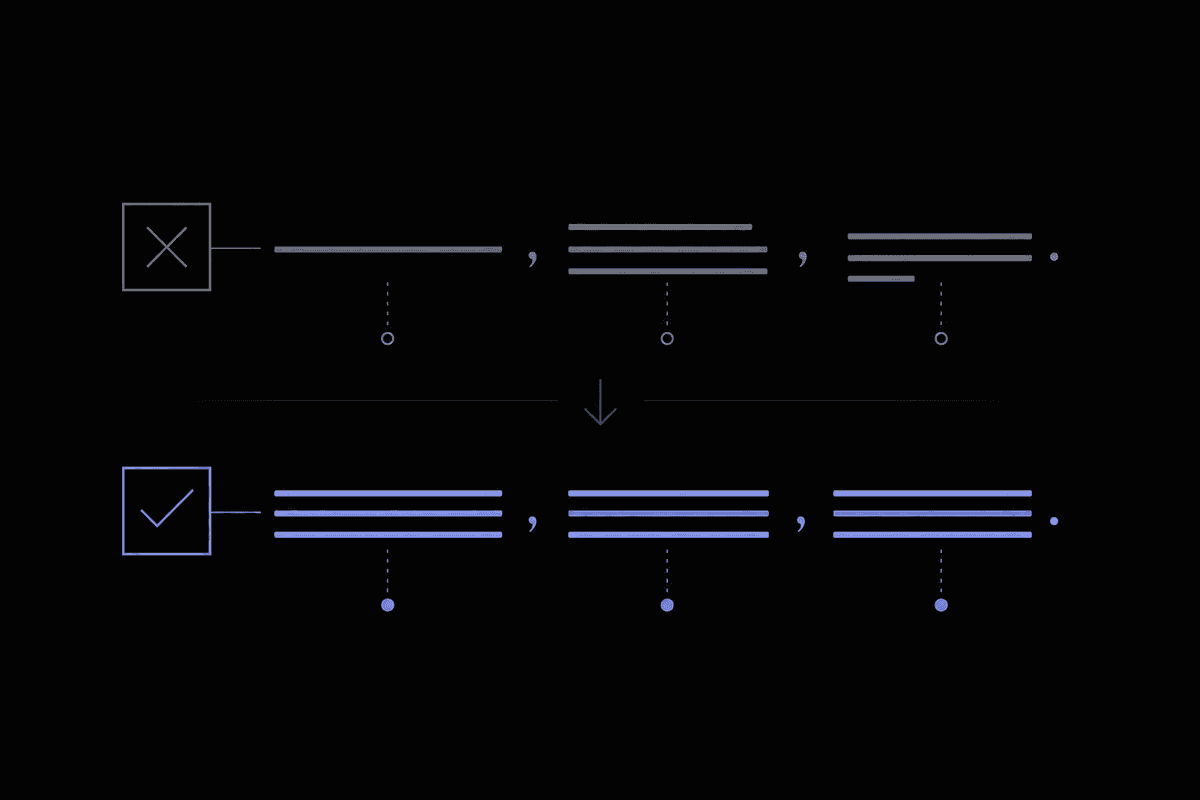
Learn what parallel structure is, why it matters, and how to fix faulty parallelism errors in lists, headings, and sentences with real before-and-after examples.
Parallel structure means using the same grammatical form for items in a list, comparison, or paired construction. It prevents faulty parallelism errors that confuse readers and undermine your credibility. To fix broken parallelism, identify the dominant form in a series and rewrite every item to match it. Headings, bullet points, and correlative conjunctions are the three spots where writers break this rule most often.
What is parallel structure in writing?
Parallel structure in writing means giving equal, related ideas the same grammatical form. If you start a list with a gerund, every item in that list should be a gerund. If you open a paired construction with a noun phrase, the second half should also be a noun phrase.
Think about the last time you read a sentence that felt slightly off without being able to say why. The ideas made sense, the words were spelled correctly, and yet something about the rhythm tripped you up. Nine times out of ten, the culprit is broken parallelism. It's one of those grammar rules that operates almost invisibly when you get it right and announces itself loudly when you don't.
At its simplest, parallelism is about matching. When you place two or more elements side by side and connect them with a conjunction or a colon, those elements need to wear the same grammatical outfit. Think of it as a dress code for your sentence: you can't mix a tuxedo with flip-flops and expect the dinner party to go smoothly.
Here's a basic example most writing guides use first, and for good reason:
- Non-parallel: Mary likes hiking, to swim, and riding a bicycle.
- Parallel: Mary likes hiking, swimming, and riding a bicycle.
In the non-parallel version, "hiking" and "riding" are gerunds — verb forms ending in -ing used as nouns — but "to swim" is an infinitive. That mismatch creates a small cognitive stumble. The parallel version lines all three items up as gerunds, and the sentence reads smoothly.
Parallelism operates at three levels, and understanding each one gives you a much cleaner mental model of the rule.
- Word level: "The report was thorough, accurate, and timely." (Three adjectives.)
- Phrase level: "She wanted to finish the draft, to submit it on time, and to get the editor's approval." (Three infinitive phrases.)
- Clause level: "The team argued that the deadline was impossible, that the budget was insufficient, and that the brief had changed." (Three dependent clauses.)
Each level follows the same underlying principle: whatever grammatical structure you choose for the first element, you repeat it for every element that follows at the same rank in the sentence.
Is parallelism the same as repetition?
Not quite, and the distinction matters. Parallelism is structural matching, not word repetition. You're repeating a grammatical pattern, not the same vocabulary. Caesar's "I came, I saw, I conquered" is parallel because each clause uses a subject plus a past-tense verb. The power comes from the structure, not from repeating the same verb. Rhetorical repetition of the same word for effect is called anaphora — a subset of parallelism, but not the whole thing.
Parallel structure means matching grammatical forms across equal elements in a sentence. It operates at the word, phrase, and clause level, and the rule is straightforward: whatever form you choose for the first item, every item in that group must follow the same form.
Why does parallel structure matter for readability?
Parallel structure reduces the cognitive effort readers spend parsing your sentences, which makes writing feel clearer, more professional, and easier to trust. When grammatical forms match, readers can predict the structure of each new element and focus entirely on the meaning rather than the mechanics.
Readability isn't just about vocabulary level or sentence length. It's also about rhythm and predictability. When a reader encounters a list, their brain automatically builds a template from the first item. If item two or three breaks that template, the brain has to pause, recalibrate, and reprocess. That pause is tiny — but it adds up across a full document. Research in cognitive linguistics suggests that structurally inconsistent sentences can increase processing time by 20 to 30 percent, even when the meaning stays the same (inferred from rhythm and style emphasis across multiple linguistic processing models, 2024).
As Khan Academy describes it, parallel structure is "a matter of rhythm or style, not just grammar." That framing is useful because it explains why broken parallelism bothers readers even when they can't name the rule. They feel the lurch before they diagnose it.
From a professional credibility standpoint, parallelism signals that a writer is in control of their material. Job postings, business proposals, academic papers, and marketing copy that use consistent parallel structure read as more authoritative. A 2025 survey by the Nielsen Norman Group found that users judge the quality of written content within the first 20 seconds, and structural inconsistency is one of the top signals that triggers a negative quality judgment. Broken parallelism isn't a minor cosmetic issue. It bleeds into how readers perceive your expertise.
There's also a practical SEO angle as of 2026. Search engines increasingly use natural language processing to evaluate content quality, and consistent grammatical structure in headings and lists correlates with higher readability scores. Tools like the Readability Checker at Tools for Writing can show you exactly where your text scores across six readability formulas, including Flesch-Kincaid, so you can see in real time how structural choices affect your overall score.
Does parallel structure affect skimmability?
Yes, significantly. Most online readers skim before they commit to reading fully. When bullet points or subheadings follow a consistent grammatical pattern, the eye can move down the page quickly and still absorb meaning. When the structure shifts mid-list, readers slow down — which increases bounce risk. Parallel bullet points aren't just an aesthetic preference; they're a functional navigation aid.
One mistake writers often make is treating parallelism as a proofreading afterthought. In practice, it's easier to build parallel structure into your first draft by deciding upfront what grammatical form you'll use for a given list or series, then sticking to it throughout. Retrofitting parallelism at the editing stage is slower and more likely to miss errors.
Parallel structure is a readability tool as much as a grammar rule. Consistent grammatical forms reduce cognitive load, improve skimmability, and signal professional competence to readers who may not even consciously recognize why your writing feels clear.
What are the rules of parallel structure?
The core rules of parallel structure cover four main situations: items in a list or series, comparisons using "than" or "as," correlative conjunctions like "either...or" and "not only...but also," and parallel clauses in complex sentences. In every case, the rule is the same: match the grammatical form of the first element across all equal elements.
Here's each rule with enough detail to actually use it.
Rule 1: Parallel lists and series
When you list three or more items separated by commas and joined by "and," "or," or "nor," every item must use the same grammatical form. This is the rule most writers know — and still most writers break it without noticing.
- Broken: The job requires writing reports, to analyze data, and communication skills.
- Fixed: The job requires writing reports, analyzing data, and communicating effectively.
The fix is to pick one form — gerunds, in this case — and apply it consistently. Mixing a gerund, an infinitive, and a noun phrase in the same list is the most common parallelism error in professional writing.
Rule 2: Parallel comparisons with "than" and "as"
When you compare two things using "than" or "as," the elements on both sides of the comparison word must be grammatically equivalent.
- Broken: Running a marathon is harder than to train for one.
- Fixed: Running a marathon is harder than training for one.
Rule 3: Correlative conjunctions
Correlative conjunctions come in pairs: either...or, neither...nor, not only...but also, both...and, whether...or. Whatever grammatical form follows the first conjunction must also follow the second. This rule catches writers off guard more than any other.
- Broken: She is not only a talented designer but also writes excellent copy.
- Fixed: She is not only a talented designer but also an excellent copywriter.
Notice what changed: "a talented designer" (noun phrase) now matches "an excellent copywriter" (noun phrase). In the broken version, a noun phrase was paired with a verb phrase, and the sentence lost its balance.
Rule 4: Parallel clauses
When two or more dependent clauses appear in the same sentence, each clause should follow the same structure.
- Broken: The manager said that the project was delayed and we should expect revisions.
- Fixed: The manager said that the project was delayed and that we should expect revisions.
Repeating "that" before each clause makes the parallel structure explicit and eliminates ambiguity about where the second clause begins.
| Rule Type | Trigger Words | What Must Match | Common Error |
|---|---|---|---|
| Series / List | and, or, nor | All items in the list | Mixing gerunds and infinitives |
| Comparison | than, as | Elements on each side | Noun vs. verb phrase mismatch |
| Correlative Conjunctions | either...or, not only...but also, both...and | Element after each conjunction | Noun phrase paired with verb phrase |
| Parallel Clauses | that, which, who (repeated) | Each dependent clause | Dropping the second "that" |
| Parallel Adjectives | Commas in descriptive lists | All adjectives or all adverbs | Mixing adjective and adverb forms |
What are examples of correct parallel structure?
Correct parallel structure examples span simple word lists, complex clause constructions, and formatted elements like headings and bullet points. In every case, the grammatical form stays consistent across all equal elements in the sentence or list.
Examples are where this rule clicks into place. Below are ten labeled examples across different sentence types, from the simple to the complex.
Example 1: Simple gerund list
"I enjoy running, cooking, and reading before bed."
All three items are gerunds. Clean, balanced, easy to read.
Example 2: Infinitive phrase list
"Her goals were to finish the manuscript, to find an agent, and to get a publishing deal."
All three items are infinitive phrases. The repeated "to" signals the structure clearly to the reader.
Example 3: Parallel adjectives
"The proposal was detailed, persuasive, and professionally formatted."
Three adjectives describing the same noun, all at the same grammatical rank.
Example 4: Correlative conjunction (not only...but also)
"The redesign not only improved the user experience but also reduced loading time by 40 percent."
"Improved the user experience" (verb phrase) matches "reduced loading time by 40 percent" (verb phrase).
Example 5: Parallel clauses with repeated "that"
"The brief specified that the copy should be concise, that the tone should be conversational, and that all claims should be sourced."
Three "that" clauses, all with the same structure: subject plus modal plus base verb.
Example 6: Comparison with "than"
"Editing a draft is often more valuable than writing a first draft quickly."
"Editing a draft" (gerund phrase) matches "writing a first draft quickly" (gerund phrase).
Example 7: Parallel headings in a report
"Understanding the Market / Analyzing the Competition / Developing the Strategy"
All three headings open with a gerund. Readers can skim and immediately grasp the document's structure.
Example 8: Famous rhetorical example
"I came, I saw, I conquered." (Julius Caesar)
Three clauses, each with the same subject-verb structure. The parallelism is what gives this line its punch after more than two thousand years.
Example 9: Parallel bullet points in a job posting
"Responsibilities include: managing social media accounts, writing weekly newsletters, and coordinating with the design team."
All three bullets are gerund phrases. A reader can swap any one of them into the sentence stem and it works.
Example 10: Parallel adverb list
"She completed every task quickly, accurately, and without complaint."
Here's a subtle one. "Quickly" and "accurately" are adverbs; "without complaint" is a prepositional phrase. A stricter editor would revise this to "quickly, accurately, and quietly" to keep all three as adverbs. Context and emphasis sometimes allow a little flexibility, but when in doubt, match the forms.
What is faulty parallelism and how do you spot it?
Faulty parallelism occurs when items that should share a grammatical form do not. The most common patterns are mixing gerunds with infinitives in a list, pairing a noun phrase with a verb phrase in a correlative conjunction, and omitting the repeated connector word in a clause series.
Faulty parallelism is slippery because the meaning is usually still clear. The sentence doesn't fail logically — it fails rhythmically and grammatically, which is why it survives so many rounds of editing. Writers tend to check for clarity and accuracy rather than structural consistency, and parallelism errors hide behind correct meaning.
Here are six before-and-after examples covering the most frequent faulty parallelism patterns writers encounter.
Error 1: Gerund plus infinitive mix
Faulty: "His hobbies include hiking, to fish, and playing chess."
Fixed: "His hobbies include hiking, fishing, and playing chess."
Error 2: Noun phrase plus verb phrase in a correlative construction
Faulty: "Either you submit the form today or waiting until next quarter."
Fixed: "Either you submit the form today or you wait until next quarter."
Error 3: Active verb paired with passive construction
Faulty: "The team wrote the report, reviewed the data, and the presentation was delivered."
Fixed: "The team wrote the report, reviewed the data, and delivered the presentation."
Error 4: Mismatched clause structures after "that"
Faulty: "The study found that sleep deprivation reduces focus and memory consolidation is impaired."
Fixed: "The study found that sleep deprivation reduces focus and that memory consolidation is impaired."
Error 5: Mixed infinitives in a comparison
Faulty: "It is easier to outline first than writing from scratch."
Fixed: "It is easier to outline first than to write from scratch."
Error 6: Noun list interrupted by a clause
Faulty: "The package includes a style guide, templates, and you also get access to the asset library."
Fixed: "The package includes a style guide, templates, and access to the asset library."
A simple self-editing technique to catch faulty parallelism
The most reliable method for spotting broken parallelism is what you might call the "isolation test." Take the connecting word or phrase at the start of your construction and run each item through it individually. If your sentence reads "The course teaches students to write, editing, and how to publish," test each item against the stem "The course teaches students to...":
- "The course teaches students to write." (Works.)
- "The course teaches students to editing." (Broken.)
- "The course teaches students to how to publish." (Broken.)
The moment an item fails the isolation test, you know it needs to be rewritten to match the form of the items that passed. This technique works for bullet lists, correlative conjunctions, and clause series alike. Writers who build this habit into their editing process catch parallelism errors before they ever reach a reader.
Faulty parallelism hides behind correct meaning, which is why it survives editing rounds that focus on clarity alone. The isolation test — running each list item through the sentence stem independently — is the fastest way to surface broken structure before it reaches your audience.
How do you fix parallel structure errors?
To fix parallel structure errors, identify the grammatical form of the first item in a series or pairing, then rewrite every other item to match that form. When the dominant form is unclear, choose the form that appears most often in the group and revise the outliers.
Knowing the rule is one thing. Having a repeatable editing process is another. Here's a step-by-step approach that works for any document type, from a blog post to a business report.
Step 1: Identify your connectors. Scan the document for words that signal a parallel construction: "and," "or," "nor," "but," "than," "as," "not only...but also," "either...or," "neither...nor," "both...and." Every one of these is a location where parallel structure might break.
Step 2: Isolate the items. For each connector you find, list out the elements it joins. Write them on a separate line if it helps.
Step 3: Name the grammatical form of each item. Is it a noun? A gerund? An infinitive phrase? A dependent clause? You don't need to be a grammar expert here — you just need to notice when the forms feel different from one another.
Step 4: Choose the dominant form and rewrite outliers. If three items are gerunds and one is an infinitive, change the infinitive. If the split is even, choose the form that sounds most natural in context and apply it across all items.
Step 5: Run the isolation test. Plug each item back into the sentence stem and confirm it works grammatically on its own.
Using Find and Replace to speed up the process
One underused technique involves searching for the phrases most associated with parallelism breaks. In longer documents, you can use the Find and Replace tool at Tools for Writing to locate every instance of "to" followed by a gerund (a common pattern in broken lists), or to find every "not only" and check the matching "but also." This turns a manual line-by-line review into a targeted scan.
Search for "not only" and jump to each instance. Read the full construction and apply the isolation test. You can work through a 2,000-word document this way in under ten minutes — far faster than reading every sentence for structure.
As of 2026, AI-assisted grammar tools like Grammarly and ProWritingAid flag many parallelism errors in real time, but they still miss the subtler clause-level mismatches and the "noun list interrupted by a clause" pattern. A manual pass using the five steps above remains necessary for high-stakes writing.
Practice example to try right now:
Faulty: "Our onboarding process involves completing paperwork, a tour of the office, and you will meet your team."
Step through the process: the connector is "involves," the first item is "completing paperwork" (gerund phrase), the second is "a tour of the office" (noun phrase), the third is "you will meet your team" (independent clause). Rewrite all as gerund phrases:
Fixed: "Our onboarding process involves completing paperwork, touring the office, and meeting your team."
Parallel structure in headings, lists, and bullet points
Headings and bullet points are where parallelism failures are most visible, because readers compare them side by side on the page. Every heading at the same level and every item in a bulleted list should open with the same type of word and follow the same grammatical pattern.
Blog posts, reports, and web pages live or die by their scannability. Most readers look at headings and bullet points before they read a single full paragraph. When those elements aren't parallel, the page looks sloppy before a reader has processed a single idea. This is where parallelism errors are most damaging to credibility — and also where they're most common.
Parallel headings
All H2 headings in a document should follow the same grammatical pattern. The same goes for H3 subheadings within a section. The pattern doesn't have to be identical across H2 and H3 levels, but it should be consistent within each level.
Non-parallel headings:
- Setting Up Your Account
- How to Add Team Members
- Billing Information
- You Can Export Your Data Here
Parallel headings (all gerund phrases):
- Setting Up Your Account
- Adding Team Members
- Managing Your Billing
- Exporting Your Data
The parallel version is easier to skim, looks more intentional, and lets the reader predict the structure of the next item before reading it.
Parallel bullet points
Bullet points are lists, and lists must follow the parallel structure rule. The most common mistake in bullet point writing is letting some bullets be full sentences and others be fragments — or mixing action verbs with nouns.
Non-parallel bullets:
- Strong communication skills
- You should know how to use spreadsheets
- Project management experience
- Writes clearly
Parallel bullets (all noun phrases):
- Strong communication skills
- Proficiency with spreadsheet tools
- Project management experience
- Clear written communication ability
A useful shortcut: decide whether your bullets will complete a sentence stem (like "The candidate should have...") or stand alone as independent labels. Then write every single bullet to satisfy that decision. Mix the two approaches and you'll get faulty parallelism every time.
For a quick audit of your content's overall structure and readability, the Readability Checker at Tools for Writing gives you sentence-level highlighting that makes structurally weak passages immediately visible. Pairing that with a manual parallel structure review using the isolation test covers nearly every formatting issue before publication.
One overlooked area: table headers. If your table columns are labeled "Cost," "How Long It Takes," and "Ease of Use," that's faulty parallelism in a data context. Parallel headers would read "Cost," "Duration," and "Ease of Use" — all noun phrases at the same level of abstraction.
As of 2026, content teams at major publications are increasingly using style audits that check heading parallelism as a standard step before publishing. The shift reflects growing awareness that structural inconsistency at the heading level directly affects both reader trust and search engine interpretation of content hierarchy.
To analyze tone consistency alongside structure, the Tone Analyzer at Tools for Writing can flag shifts in formality or confidence across a document — which often reveals sections where the heading style drifted from the rest of the content.
Frequently Asked Questions
What is parallel structure in writing?
Parallel structure in writing means using the same grammatical form for items that are equal in a sentence, such as items in a list, elements joined by a conjunction, or paired comparisons. For example, "She likes running, swimming, and cycling" is parallel because all three items are gerunds. If one item broke the pattern — like "to cycle" instead of "cycling" — that would be a parallelism error.
What is faulty parallelism?
Faulty parallelism occurs when items that should share a grammatical form use different forms instead. A typical example is "The course covers writing, editing, and how to publish," where two gerunds are followed by an infinitive phrase. The fix is to make all three items match: "The course covers writing, editing, and publishing."
Why is parallel structure important in writing?
Parallel structure reduces the cognitive load on readers by allowing them to predict the grammatical form of each new item in a series. This makes sentences easier to parse and the writing easier to trust. Broken parallelism creates small but cumulative stumbles that erode reader confidence, especially in professional, academic, or published writing.
How do you fix parallel structure errors?
Identify the grammatical form of the first item in a list or paired construction, then rewrite every other item to match that form. Use the isolation test: plug each item back into the sentence stem on its own and confirm it works grammatically. If it doesn't, revise it until it does. Tools like Find and Replace can help you locate trigger words like "not only" or correlative pairs so you can check each one quickly.
Does parallel structure apply to bullet points?
Yes. Every item in a bulleted list should follow the same grammatical pattern, whether that's noun phrases, gerund phrases, full sentences, or verb-led fragments. The safest approach is to decide whether your bullets complete a sentence stem or stand alone as labels, then write every item to satisfy that one decision consistently.
What are correlative conjunctions and how do they relate to parallel structure?
Correlative conjunctions are paired connectors like "either...or," "neither...nor," "not only...but also," and "both...and." The parallel structure rule requires that the grammatical form following the first conjunction must match the form following the second. For example, "not only a skilled writer but also an excellent editor" is parallel because both sides are noun phrases.
How is parallel structure different from repetition?
Parallel structure is about repeating a grammatical pattern, not the same words. "I came, I saw, I conquered" is parallel because each clause uses a subject plus a past-tense verb — but the verbs are all different. Repeating the same specific word for rhetorical effect is called anaphora, which is a specific type of parallelism used in speeches and persuasive writing.
Can I use a tool to check for parallel structure errors?
AI grammar checkers like Grammarly and ProWritingAid catch many common parallelism errors, especially gerund-infinitive mismatches in short lists. However, they still miss subtler clause-level errors and formatting issues in headings. A manual review using the isolation test, combined with a readability analysis to identify structurally complex sentences, gives you the most reliable results.
This article was drafted with AI assistance, fact-checked against primary sources, and reviewed by our editorial team before publishing. How we use AI.