

Run-on sentences killing your credibility? Learn the 4 fixes—periods, semicolons, and conjunctions—plus a checklist to catch every error before readers do.
A run-on sentence happens when two or more independent clauses are joined without proper punctuation or connecting words. The two main types are fused sentences (no punctuation at all) and comma splices (only a comma between clauses). You can fix them four ways: add a period, use a semicolon, add a coordinating conjunction, or use a subordinating conjunction. Use a readability checker to catch them before your readers do.
What is a Run-On Sentence?
A run-on sentence occurs when two or more independent clauses are connected without the correct punctuation or a proper joining word. The result is a single sprawling sentence where separate ideas crash into each other, leaving readers uncertain about where one thought ends and the next begins.
Picture this: you're editing a colleague's draft and you hit a sentence that makes you stop, back up, and re-read it twice before the meaning clicks. Odds are good a run-on is the problem. These errors show up everywhere — blog posts, business emails, college essays, even published articles. Knowing how to fix run-on sentences is one of the fastest ways to sharpen your writing at any level.
Here's the clearest way to think about it. An independent clause contains a subject and a verb and expresses a complete thought. "The meeting ran late" is one. "Everyone missed lunch" is another. Shove both ideas into a single sentence without the right grammatical glue, and you've got a run-on.
There are two primary forms this error takes. The first is a fused sentence, where two independent clauses sit side by side with nothing between them:
The meeting ran late everyone missed lunch.
The second is a comma splice, where a lone comma stands in for a proper boundary between two complete thoughts:
The meeting ran late, everyone missed lunch.
A comma doesn't have that authority. That's the core rule. Writers reach for one instinctively because they sense a pause is needed — but a pause and a grammatical boundary aren't the same thing.
Why does this matter beyond grammar class? Because run-ons genuinely slow readers down. When two independent ideas blend together without a clear dividing signal, readers have to do extra cognitive work to parse meaning. According to research from the Nielsen Norman Group, readers already skim online content aggressively, and anything that creates friction causes them to disengage faster. A sentence that forces someone to backtrack is a sentence that quietly erodes your credibility.
Editors at publishing houses and content teams consistently flag run-ons as a sign that a writer hasn't yet mastered sentence control. In academic writing, they can directly affect grades. In professional contexts, they can undermine trust in a document before the reader even reaches the main argument.
Is a long sentence always a run-on?
No — and this misconception is worth clearing up. A sentence can be fifty words long and be grammatically correct if its clauses are properly connected. A run-on is specifically about missing or incorrect punctuation between independent clauses, not about length. Keep that distinction in mind as you edit.
A run-on sentence is a punctuation and structure problem, not simply a length problem. Two independent clauses joined without correct punctuation create either a fused sentence or a comma splice.
What Are the Different Types of Run-On Sentences?
The two main types of run-on sentences are fused sentences, where independent clauses are joined with no punctuation at all, and comma splices, where only a comma separates two independent clauses. Both are sentence boundary errors, but they look slightly different on the page and respond to the same set of fixes.
Knowing which type you're dealing with makes it easier to choose the right correction. Here's a closer look at both, with enough examples that you can start recognizing them in your own drafts.
Fused Sentences
A fused sentence joins two complete thoughts with absolutely nothing between them — no comma, no period, no conjunction. The clauses simply run together as if they're one continuous idea.
- She submitted the report the client approved it immediately.
- The server crashed we lost three hours of work.
- He finished the first chapter the second one was harder to write.
- The deadline moved up nobody on the team had enough time.
Each example contains two clearly separate events. Without any punctuation to divide them, readers have to work out where one ends and the next begins — often by starting over from the top. That's effort no reader should have to spend.
Comma Splices
A comma splice looks slightly more polished because at least there's punctuation present. The problem is that a comma alone doesn't carry enough grammatical authority to separate two independent clauses. Writers often produce them because they sense the need for a pause, but a pause isn't a sentence boundary.
- The project is due Friday, we haven't started the research yet.
- She loves writing blog posts, she hates editing them.
- The coffee shop was packed, there were no tables left.
- His presentation was strong, the data behind it was weak.
Comma splices are arguably the more common of the two error types, especially in informal writing and emails. According to Purdue OWL, they're among the most frequently flagged errors in college writing — and they appear with similar frequency in professional content.
A common mistake writers make
Many writers believe that dropping a conjunctive adverb like "however," "therefore," or "then" after a comma is enough to fix a run-on. It isn't. "She loves writing, however she hates editing" is still a comma splice. Conjunctive adverbs aren't coordinating conjunctions — they need either a semicolon before them or a fresh sentence: "She loves writing; however, she hates editing." or "She loves writing. However, she hates editing."
| Type | What's Missing | Example | Frequency in Writing |
|---|---|---|---|
| Fused Sentence | Any punctuation or conjunction | The alarm rang she didn't wake up. | Common in rushed drafts |
| Comma Splice | Proper punctuation (only a comma used) | The alarm rang, she didn't wake up. | Very common in emails and blogs |
| Comma + Conjunctive Adverb Splice | Semicolon before conjunctive adverb | The alarm rang, however she didn't wake up. | Common in academic and formal writing |
Why Do Run-On Sentences Hurt Your Writing?
Run-on sentences slow readers down, create ambiguity, and signal a lack of control over language. In digital content, they also affect how search engines parse and index your text, which can reduce your content's visibility and authority signals.
The damage run-ons do goes well beyond grammar scores. There are real, measurable consequences for readability, reader trust, and even search performance.
Start with the human side. Readers process writing in chunks — every sentence is a unit of thought. When that unit bleeds into the next without a clear boundary, the brain has to do extra work to assign meaning. Research on reading comprehension consistently shows that well-punctuated, clearly bounded sentences are processed faster and retained better than sentences with structural errors. When you write run-ons, you're essentially asking your reader to do your editing for you. Most won't.
There's also a credibility dimension. Whether fair or not, readers associate grammatical errors with unreliable information. A 2021 study by Global Lingo found that 59% of respondents said they would not use a company that had obvious grammatical errors on its website. With audiences having more choices than ever about where to get information, run-ons and comma splices give readers an easy reason to click away.
For SEO, the impact is more nuanced but still real. Search engines like Google use Natural Language Processing to understand the structure and meaning of content. According to the University of Michigan's writing center, sentence boundary errors disrupt the coherent flow of ideas that NLP models rely on to evaluate content quality. Google hasn't published a specific penalty for run-ons, but content with poor sentence structure tends to score lower on readability metrics — and readability does factor into overall content quality assessments. Running your content through a readability checker before publishing gives you a concrete view of where sentence structure is breaking down.
Does sentence length affect readability scores?
Yes, directly. Tools that measure readability using formulas like Flesch-Kincaid and Gunning Fog penalize long, complex sentences. Run-ons inflate sentence length artificially, which can push your readability score into ranges that are difficult for average readers to process. A word counter with sentence analysis helps you spot sentences that have grown out of control.
Run-on sentences damage reader trust, slow comprehension, and can affect your content's readability scores in ways that influence search visibility. Fixing them is both a writing quality issue and a practical performance issue.
4 Ways to Fix a Run-On Sentence
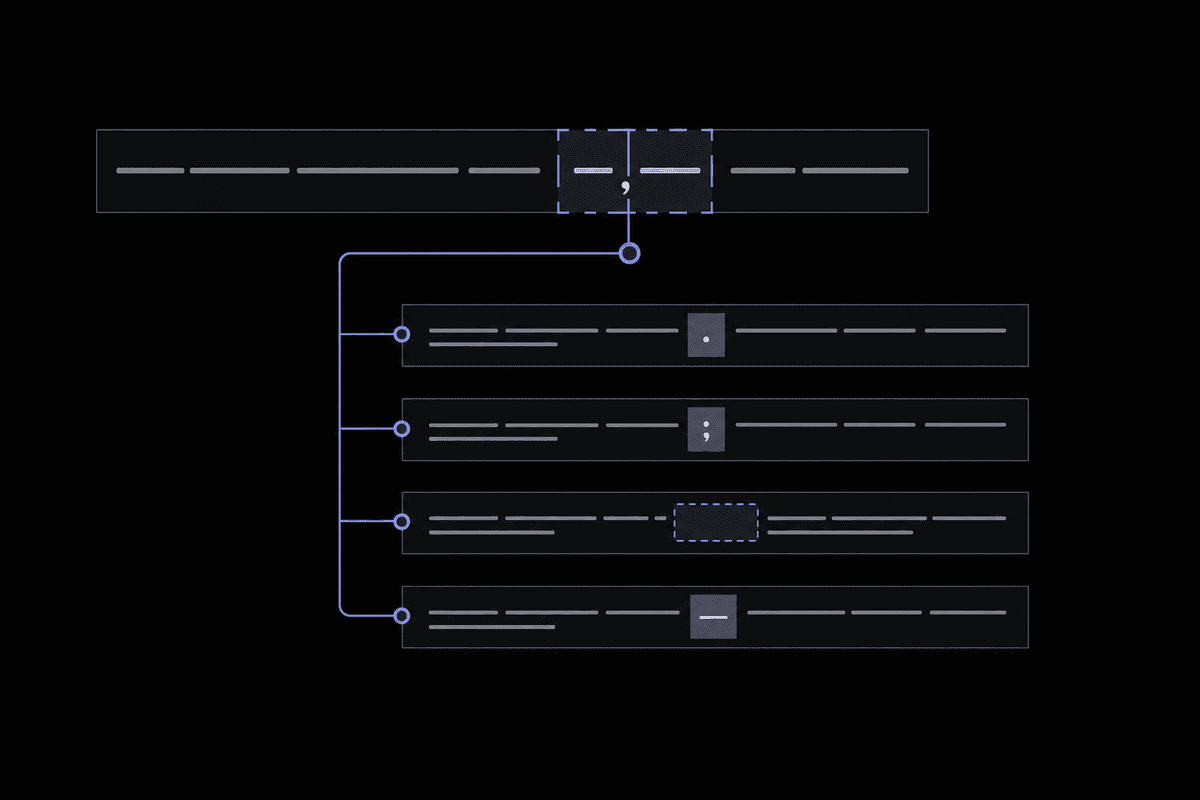
There are four reliable methods to fix a run-on sentence: separate the clauses with a period, connect them with a semicolon, add a coordinating conjunction, or use a subordinating conjunction to show the relationship between clauses. Each method creates a different effect, so the right choice depends on what you want the sentence to communicate.
Every run-on fix comes down to one goal: clearly marking where one independent clause ends and another begins. Here are the four methods, each with a before-and-after example.
Method 1: Use a Period
The simplest fix. Split the run-on into two separate sentences. This works especially well when the two clauses are equally important and don't share a logical relationship that needs to be made explicit.
Before: The client approved the design the team celebrated with dinner.
After: The client approved the design. The team celebrated with dinner.
Periods create short, punchy sentences. In fast-paced writing — news articles, social media, direct emails — this is often the right call. That said, leaning on it too heavily makes writing feel choppy, so vary your approach across a full draft.
Method 2: Use a Semicolon
A semicolon is the right tool when two independent clauses are closely related in meaning and you want to signal that connection without a conjunction. It creates a stronger pause than a comma but a softer break than a period.
Before: The data looked promising, the methodology was flawed. (comma splice)
After: The data looked promising; the methodology was flawed.
Semicolons suit formal writing, academic papers, and analytical content well. One common mistake is overusing them — if every other sentence contains one, the rhythm becomes heavy and monotonous.
Method 3: Add a Coordinating Conjunction
The seven coordinating conjunctions — for, and, nor, but, or, yet, so — are memorized with the acronym FANBOYS. Adding one after a comma between two independent clauses correctly fixes a comma splice and establishes a clear logical relationship.
Before: She wanted to revise the draft, she ran out of time. (comma splice)
After: She wanted to revise the draft, but she ran out of time.
Choosing the right conjunction matters. "But" signals contrast. "So" signals result. "And" signals addition. The word you pick changes the meaning, so choose deliberately rather than defaulting to "and" every time.
Method 4: Use a Subordinating Conjunction
Subordinating conjunctions — because, although, since, while, when, if, unless, after, before — turn one independent clause into a dependent one. This method is particularly useful when one idea is more important than the other, or when you want to show a cause-and-effect or time relationship.
Before: The project failed they didn't test the assumptions. (fused sentence)
After: The project failed because they didn't test the assumptions.
This approach gives you the most control over emphasis. The clause you subordinate becomes the supporting idea; the independent clause carries the main weight. Use it when the relationship between clauses is specific and meaningful.
The four methods to fix a run-on each serve a different purpose. Periods create separation, semicolons signal close connection, coordinating conjunctions show logical relationships, and subordinating conjunctions establish hierarchy between ideas.
How Do You Find Run-On Sentences in Your Writing?
The most effective ways to find run-on sentences are reading your draft aloud, checking for unusually long sentences, and using a readability tool that highlights sentence structure issues. Most writers miss their own run-ons because they read what they meant to write, not what they actually wrote.
Finding run-ons is harder than fixing them. The brain is remarkably good at smoothing over errors when you already know what a sentence is supposed to say. These techniques work in practice.
Read Your Draft Aloud
This is the single most effective self-editing technique for sentence boundary errors. Reading silently lets your brain paper over problems; reading aloud forces every word to carry its actual spoken weight. Run-on sentences will make you pause in awkward places or run out of breath before you reach a period. That physical discomfort is the signal. Every time you stumble or feel the urge to breathe where there's no punctuation, mark it for review.
Check Sentence Length Systematically
Not every long sentence is a run-on, but most run-ons are long sentences. A practical threshold many editors use: any sentence over 40 words deserves a second look, and anything over 60 words should almost certainly be broken up or restructured. A word counter that shows sentence-level analysis makes this check fast and objective rather than relying on your own perception.
Use a Readability Tool
Readability checkers do more than calculate grade level. A good one highlights individual long sentences, flags passive constructions, and shows you where sentence variety has collapsed into uniform, unbroken blocks of text. The readability checker at Tools for Writing analyzes text against six different formulas and highlights problematic sentences directly in the editor, making it straightforward to spot where run-ons are dragging your score down.
Use Find and Replace to Check for Comma Splices
One underused technique: run a find and replace tool searching for commas followed by personal pronouns — ", I", ", he", ", she", ", they", ", we", ", it". Independent clauses frequently begin with a subject pronoun, so these patterns surface a large percentage of comma splices quickly. It won't catch every case, but it's a fast first pass.
A common mistake in self-editing
Writers often edit for run-ons one sentence at a time, in isolation. In practice, run-ons tend to cluster at the paragraph level — when a writer gets into a rhythm and starts joining thoughts automatically. Editing full paragraphs as units helps you catch the structural patterns that produce repeated errors, not just the individual instances.
Run-On Sentence Examples: Before and After
Seeing run-on sentences corrected in context is the fastest way to internalize the rules. The examples below come from common writing situations — blog posts, business emails, and academic essays — each showing the error and two or more correction options.
Real-world run-ons don't always look as obvious as textbook examples. Here are ten cases drawn from the kinds of writing most people actually produce.
1. Blog post (fused sentence):
Before: Content marketing has changed dramatically over the past decade SEO alone is no longer enough to drive traffic.
After (period): Content marketing has changed dramatically over the past decade. SEO alone is no longer enough to drive traffic.
After (conjunction): Content marketing has changed dramatically over the past decade, and SEO alone is no longer enough to drive traffic.
2. Business email (comma splice):
Before: I've reviewed the proposal, I have a few suggestions for the pricing section.
After (period): I've reviewed the proposal. I have a few suggestions for the pricing section.
After (subordinating): After reviewing the proposal, I have a few suggestions for the pricing section.
3. Academic essay (fused sentence):
Before: The experiment produced unexpected results the researchers had to revise their hypothesis.
After (semicolon): The experiment produced unexpected results; the researchers had to revise their hypothesis.
After (conjunction): The experiment produced unexpected results, so the researchers had to revise their hypothesis.
4. Product description (comma splice):
Before: This laptop is lightweight and portable, it fits easily into any bag.
After: This laptop is lightweight and portable. It fits easily into any bag.
5. News article (fused sentence):
Before: The company announced record profits the stock price jumped 12% in after-hours trading.
After: The company announced record profits, and the stock price jumped 12% in after-hours trading.
6. Social media caption (comma splice):
Before: The event sold out in three hours, we're already planning the next one.
After: The event sold out in three hours. We're already planning the next one.
7. Cover letter (fused sentence):
Before: I have five years of experience in project management I am confident I can lead this team.
After: I have five years of experience in project management, and I am confident I can lead this team.
8. Instruction manual (comma splice):
Before: Press the power button to start the device, the screen will illuminate within five seconds.
After: Press the power button to start the device. The screen will illuminate within five seconds.
9. Fiction writing (fused sentence):
Before: The door swung open cold air filled the room.
After (semicolon for dramatic effect): The door swung open; cold air filled the room.
10. Report executive summary (comma splice):
Before: Customer satisfaction scores declined in Q3, the primary cause was shipping delays.
After (subordinating): Customer satisfaction scores declined in Q3 because of shipping delays.
Are There Times When Long Sentences Are Okay?
Yes. A long sentence that is grammatically correct, with properly connected clauses, is not a run-on. In literary writing, intentionally long sentences can create rhythm, accumulate detail, and build emotional momentum. The key distinction is control: a deliberate long sentence versus an accidental run-on.
This is where many grammar guides get it wrong. They treat length as the problem, which leads writers to chop every long sentence into short fragments — and the result is writing that sounds robotic, stripped of any texture or personality.
Professional writers use length deliberately. Long sentences slow readers down and ask them to hold multiple ideas in suspension at once. Depending on how they're structured, they can create a feeling of overwhelming detail, breathless urgency, or meditative calm. The sentence is long by design, and every clause is properly connected. That's the opposite of a run-on.
The practical test is simple: can you identify how every clause in the sentence connects to the next? If yes, and if each connection is grammatically sound, the sentence is long but correct. Find two independent clauses sitting next to each other without a conjunction or proper punctuation, though, and that's a run-on — regardless of how intentional it felt when you wrote it.
Sentence variety is a related but separate concept. Writing coaches and style guides consistently recommend mixing sentence lengths to keep readers engaged. A stretch of all short sentences sounds choppy. A stretch of all long ones becomes exhausting. The best writing moves between lengths with purpose, and readability research continues to affirm that sentence variety is one of the clearest signals of skilled, engaging prose.
What about stream-of-consciousness style?
Some literary traditions deliberately use run-on structures to mimic the way thought actually flows. Writers like James Joyce and William Faulkner used this as an intentional stylistic device. That technique requires a level of craft and intentionality that's appropriate in literary fiction — not in blog posts, reports, or business communication. In functional writing, accidental run-ons are never an asset.
Run-On Sentence Checklist for Self-Editing
A systematic checklist applied at the editing stage catches run-ons before they reach readers. The steps below move from quick visual scanning to deeper structural review, and they apply whether you're editing a blog post, an essay, or a professional email.
Run through this checklist every time you edit a draft. It takes less than ten minutes and catches the majority of sentence boundary errors that a quick re-read misses.
- Step 1: Identify every sentence over 40 words. Flag it. It may be fine, but it needs a deliberate look. A word counter with sentence-level analysis does this automatically.
- Step 2: For every flagged sentence, find the subject and verb of each clause. If there are two complete subject-verb pairs, check how they're connected. Is there a coordinating conjunction? A subordinating conjunction? A semicolon? If none of the above, you have a run-on.
- Step 3: Scan for commas that appear between two complete thoughts. Ask: could each side of this comma stand alone as a sentence? If yes, and there's no coordinating conjunction after the comma, you have a comma splice.
- Step 4: Check every use of "however," "therefore," "then," and "also" that follows a comma. These are conjunctive adverbs, not coordinating conjunctions. They need a semicolon before them or a new sentence.
- Step 5: Read the draft aloud from end to beginning, one sentence at a time. Reading in reverse breaks the narrative flow and forces you to evaluate each sentence as a standalone unit.
- Step 6: Run the draft through a readability tool. The readability checker highlights long and structurally complex sentences, giving you a visual map of where problems cluster.
- Step 7: Search for common comma splice patterns using a find-and-replace tool. Try searching for ", I ", ", he ", ", she ", ", we ", ", they ". Each result is a potential comma splice worth reviewing.
- Step 8: After fixing, re-read for sentence variety. Make sure your corrections haven't created a wall of identical short sentences. Mix periods, semicolons, and conjunctions across your fixes.
The most common mistake writers make with this checklist is skipping Step 2. Flagging long sentences is easy. Actually parsing whether the clauses inside them are correctly connected requires real attention. Don't let a sentence's overall coherence trick you into thinking its punctuation is correct — the logic can be perfectly clear while the grammar is still broken.
AI writing tools have gotten much better at flagging surface-level errors, but they still miss context-dependent run-ons with some regularity. A human checklist combined with a reliable readability tool remains the most dependable approach for writers who care about getting it right.
Frequently Asked Questions
What are the 5 rules to fix a run-on sentence?
The five most commonly cited rules are: (1) separate clauses with a period to form two sentences, (2) use a semicolon between closely related independent clauses, (3) add a coordinating conjunction (for, and, nor, but, or, yet, so) after a comma, (4) use a subordinating conjunction to make one clause dependent, and (5) restructure the sentence to eliminate the second independent clause entirely. The first four are the most practical for everyday editing; the fifth is most useful when a sentence is simply trying to do too much at once.
What is the best way to fix a run-on sentence?
The best fix depends on the relationship between the two clauses. If they're equally important and loosely connected, a period works best. If they're closely related, a semicolon or coordinating conjunction preserves that connection while correcting the error. If one clause explains or qualifies the other, a subordinating conjunction is the strongest choice. There's no single best method across all cases, which is why understanding each option matters.
What is a run-on sentence example?
A fused sentence example: "The report was due Monday nobody had started writing it." A comma splice example: "The report was due Monday, nobody had started writing it." Both are run-ons because they join two independent clauses incorrectly. Corrected versions include: "The report was due Monday, but nobody had started writing it." or "The report was due Monday. Nobody had started writing it."
What is a comma splice and how do I fix it?
A comma splice is a specific type of run-on sentence where two independent clauses are joined only by a comma, without a coordinating conjunction. For example: "I finished the draft, it still needs revision." To fix it, add "but" after the comma, replace the comma with a period, or use a semicolon: "I finished the draft, but it still needs revision." Comma splices are among the most common sentence boundary errors in both informal and professional writing.
Is a long sentence always a run-on sentence?
No. Length alone doesn't make a sentence a run-on. A sentence can be long and grammatically correct if all its clauses are properly connected with the right punctuation and conjunctions. A run-on specifically refers to two or more independent clauses joined without correct punctuation or a proper connecting word. A 60-word sentence with correctly used subordinating conjunctions and semicolons is not a run-on.
Can I use a semicolon to fix any run-on sentence?
Technically yes, but not always appropriately. A semicolon works well when two independent clauses are closely related in meaning and you want to show that connection on the page. If the clauses are loosely related or very different in tone, a period is usually the better choice. Overusing semicolons also creates a heavy, formal rhythm that can feel stilted in conversational or informal writing.
How does a run-on sentence affect SEO?
Run-on sentences can negatively affect SEO indirectly by lowering readability scores, which are part of overall content quality signals. Search engines use Natural Language Processing to evaluate content structure, and poor sentence boundaries can make it harder for these systems to accurately parse meaning and topic relevance. Content that's difficult to read also tends to have higher bounce rates, which is a negative user engagement signal. Fixing run-ons improves both human readability and machine-readable structure.
What tools can help me find run-on sentences?
Several tools help identify run-on sentences at different levels of depth. A readability checker highlights long and complex sentences using multiple scoring formulas, making structural problems visible at a glance. A word counter with sentence analysis helps you track sentence length across an entire document. A find and replace tool lets you search for common comma splice patterns quickly. Using all three together gives you a thorough editing workflow that catches the majority of run-on errors before publication.
This article was drafted with AI assistance, fact-checked against primary sources, and reviewed by our editorial team before publishing. How we use AI.