

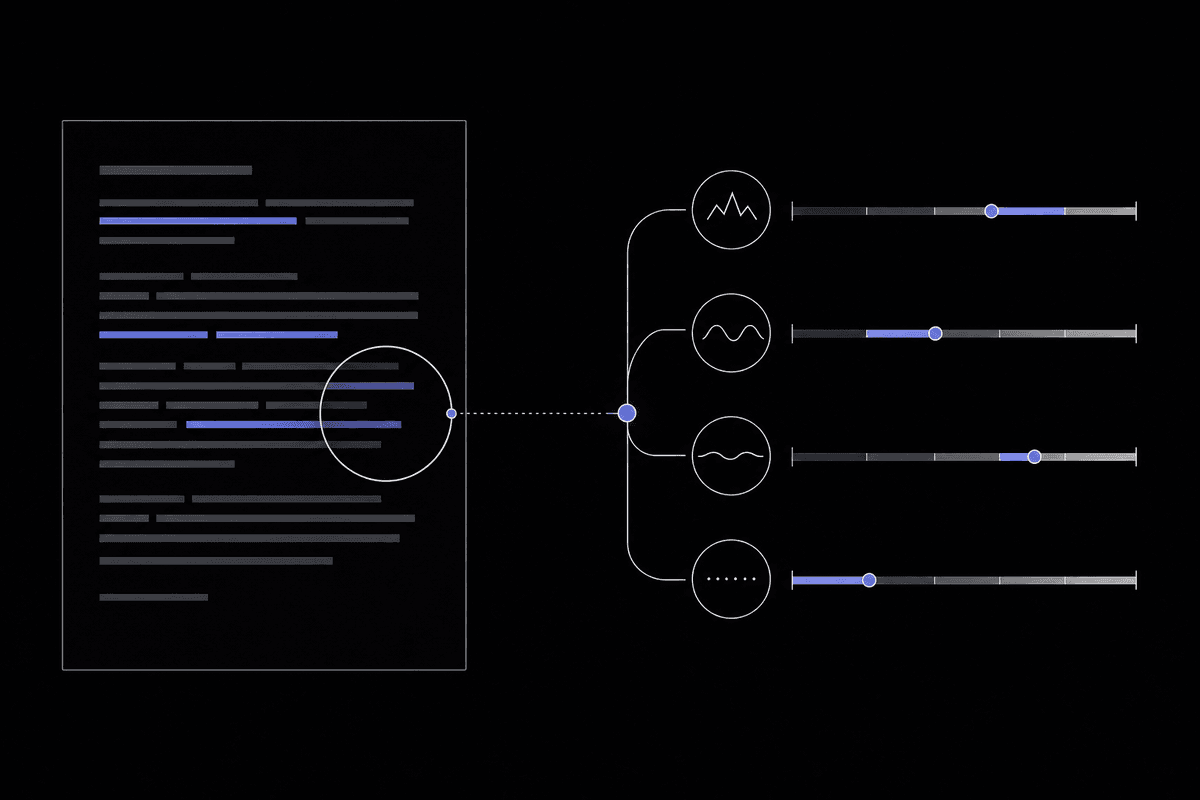
Tone in writing shapes whether readers trust, engage, or ignore you. Learn every type, how to analyze it, and how to adjust it for any audience or context.
Tone in writing is the attitude or emotional perspective an author conveys through word choice, sentence structure, and detail selection. It differs from voice (your consistent style) and mood (the atmosphere readers feel). Mastering tone means knowing how to shift it deliberately for emails, blog posts, academic papers, and social media without losing your core message. The sections below walk you through every layer, from identifying tone in someone else's work to fixing the most common tone mistakes that quietly erode reader trust.
What is Tone in Writing?
Tone in writing is the attitude or emotional perspective an author communicates toward their subject or audience, expressed through word choice, syntax, punctuation, and the details they choose to include or omit. Think of it as the written equivalent of the way someone's voice sounds when they speak to you — the same words delivered with warmth versus cold efficiency create entirely different impressions. Tone is not the same as voice, mood, or style, though all four are closely related.
Read any company's refund policy and you'll often feel vaguely accused of fraud before you've even submitted a request. The sentences are probably grammatically correct. But the attitude behind them — defensive, suspicious, written as though every customer is a potential bad actor — is tone doing its work. It shapes every interaction you have with written language, whether you notice it consciously or not.
A simple analogy helps here. Imagine you're asking a coworker to move a meeting. "Sure, no problem — let me know what works for you" is cooperative and warm. "Very well, I will adjust my schedule accordingly" is formal, slightly stiff, maybe a little cold. "I suppose I can find time" reads as passive-aggressive. Same basic message. Very different attitude. That shift in attitude is exactly what tone means in writing.
Purdue OWL defines it clearly: "Tone refers to the author's attitude — how they feel about their subject and their readers. It expresses something of the author's persona." That definition points to something writers often overlook: tone is directed at both the subject and the audience simultaneously.
Here are three quick examples of how tone changes the same content:
- Formal: "The report indicates a 12% decline in quarterly revenue attributable to supply chain disruption." (Objective, no emotional signals, suitable for a board presentation.)
- Conversational: "So our revenue took a hit this quarter — about 12% — mostly because of supply chain headaches." (Relaxed, approachable, suitable for an internal team update.)
- Alarmed: "We are down 12% this quarter and supply chain problems are to blame. This cannot continue." (Urgent, tense, designed to prompt immediate action.)
The facts are identical. The tone reframes how those facts land with the reader.
One common mistake writers make is confusing tone with emotion. Raw emotion is what an author feels while writing. Tone is the controlled, crafted expression of attitude that reaches the reader. A writer can be genuinely furious about an injustice but choose a measured, authoritative tone because that will actually persuade people — rather than a ranting tone that might alienate them. Tone is a deliberate choice, not an accidental leak of feeling.
Mood is a related but distinct concept. Mood is the atmosphere a piece creates for the reader — the emotional environment a story or article conjures. A horror story can have an eerie mood while the narrator maintains a detached, clinical tone. Tone comes from the author's attitude; mood is the reader's emotional experience of the text. Both matter, but they operate on different levels.
Tone is the author's expressed attitude toward subject and audience, shaped by deliberate word choices and structure. It is distinct from voice, mood, and raw emotion — and it changes based on context even when your core message stays the same.
What is the Difference Between Tone and Voice in Writing?
Voice is the consistent personality that runs through all of a writer's work — their signature style, perspective, and way of seeing the world. Tone is situational; it shifts depending on audience, purpose, and context, even within the same piece. A useful way to think about it: voice is who you are as a writer, and tone is how you choose to speak in a given moment.
The confusion between tone and voice is genuinely common, even among experienced writers. They're related, and they interact constantly, but they're not the same thing. Here's the clearest way to separate them: your voice doesn't change. Your tone does.
Consider a writer known for sharp, slightly sardonic observations about human nature. That quality — the dry wit, the willingness to notice what others politely ignore — is their voice. When they write a personal essay about grief, they don't abandon that voice, but they lower the sarcasm and adopt a more tender, reflective tone. When they write a satirical op-ed, that same voice produces something biting and exaggerated. Same personality. Different registers.
The table below makes the distinction concrete:
| Aspect | Voice | Tone |
|---|---|---|
| Definition | The author's consistent personality and style across all work | The author's attitude in a specific piece or moment |
| Consistency | Stays the same across contexts | Shifts based on audience, purpose, and subject |
| How it appears | Sentence rhythm, recurring themes, perspective | Word choice, punctuation, formality level |
| Can you control it? | Develops organically over time; partially controllable | Highly controllable and should be adjusted deliberately |
| Example | Always direct, economy of words, data-driven | Formal in a white paper, encouraging in a newsletter |
| Reader perception | "I always know who wrote this." | "This feels right for the situation." |
A real-world business example: imagine a SaaS company whose brand voice is knowledgeable, direct, and slightly irreverent. That voice shows up consistently across their website, product docs, and social media. But the tone shifts. Their error messages are calm and helpful. Their promotional emails are enthusiastic and urgent. Their terms of service are formal and precise. Same voice. Four different tones.
Writers often struggle when they confuse the two and try to keep tone consistent the same way they keep voice consistent. That produces writing that feels weirdly uniform — a blog post that reads like a legal brief, or a customer apology that sounds like a press release. Knowing which element to adjust, and when, is one of the more practical skills you can develop as a writer.
What about mood — where does that fit in?
Mood is the third point of this triangle. If voice is the author's personality and tone is the author's attitude, mood is what the reader feels as a result. A piece written in a melancholy tone by a consistently reflective voice creates a sad mood in the reader. Mood is the effect; tone is one of the causes. In business writing, mood is rarely discussed explicitly, but it's always present. A collections email that creates a mood of shame in the reader may produce short-term compliance but long-term customer loss — which is a real cost worth considering.
What Are the Main Types of Tone in Writing?
The main types of tone in writing include formal, informal, conversational, authoritative, empathetic, sarcastic, optimistic, urgent, humorous, and assertive, among many others. Each tone serves a specific communicative purpose and works best in particular contexts. The right tone is never about personal preference alone — it is about matching your attitude to your audience's expectations and your content's goals.
Tone doesn't come in ten neat boxes. Writers estimate there are dozens of distinct tones, and skilled authors blend them. That said, certain tones appear again and again across professional and creative writing, and knowing them by name makes it easier to deploy them deliberately. Here are twelve of the most important, with a concrete one-sentence example of each:
- Formal: "The board has resolved to restructure the organization's operational divisions effective the first quarter of the fiscal year." (Used in reports, legal documents, academic papers.)
- Informal: "We're shaking things up in Q1 — big changes are coming to how we're organized." (Suitable for internal memos, casual blog posts, SMS updates.)
- Conversational: "Here's the thing about restructuring — it sounds scary, but it usually means better teams and clearer roles." (Works well in newsletters, explainer content, how-to guides.)
- Authoritative: "Based on three years of internal data and industry benchmarks, this approach is the most cost-effective option available." (Effective in thought leadership, expert guides, white papers.)
- Empathetic: "We understand this news is difficult, and we want to make this transition as smooth as possible for everyone affected." (Critical in customer service communications, HR announcements, crisis messaging.)
- Sarcastic: "Oh sure, adding another approval layer will definitely speed things up." (High-risk in professional contexts; effective in satire, criticism, and comedy.)
- Optimistic: "These changes position us to grow faster and serve our customers better than ever before." (Common in marketing copy, fundraising appeals, motivational content.)
- Urgent: "Act now — this offer expires at midnight and we only have 12 spots remaining." (Drives immediate action in sales copy, event promotions, emergency communications.)
- Humorous: "If spreadsheets could talk, ours would beg for mercy — so we built a better system." (Builds engagement in brand content, social media, and internal culture communications.)
- Assertive: "I firmly believe this strategy is the right move, and here is the evidence that supports it." (Useful in persuasive essays, proposals, leadership communications.)
- Encouraging: "You've already done the hardest part — the rest of this process is straightforward, and you're well-equipped to handle it." (Effective in onboarding materials, coaching content, educational writing.)
- Critical: "The current process is inefficient, inconsistently applied, and costing the organization measurable time and money." (Used in audits, performance reviews, investigative journalism.)
What most people miss is that tones aren't mutually exclusive. A well-crafted fundraising letter might be simultaneously empathetic, urgent, and optimistic. A strong executive memo might be authoritative and conversational at the same time. The goal isn't to pick one tone and apply it robotically — it's to blend tones intentionally based on what the moment requires.
One mistake that appears often in business writing is leaning too heavily on assertive or authoritative tones without balancing them with empathy. According to Grammarly's 2026 communication research, messages perceived as authoritative but not empathetic are significantly less likely to generate positive responses in professional settings. The data reinforces what good writers already know intuitively: readers respond to being treated as human beings, not just recipients of information.
Knowing the names and functions of different tones gives you a practical vocabulary for deliberate choices. The best writing blends tones purposefully rather than defaulting to one register throughout.
How Does Tone Affect Your Reader?
Tone directly influences whether a reader trusts you, keeps reading, takes action, or disengages entirely. In business writing, the wrong tone can cost you a client or erode team morale; in creative writing, a mismatched tone breaks immersion and distances the reader from the story. Tone is not decoration — it is one of the primary mechanisms through which writing succeeds or fails at its purpose.
Reedsy's writing guides note that tone controls the "distance" between the reader and the narrator. First-person writing with a warm, conversational tone creates intimacy — the reader feels like someone is talking directly to them. Third-person writing with a detached, clinical tone creates distance — useful in academic contexts but alienating in marketing copy. That distance isn't neutral. Every tone choice positions the reader somewhere on a spectrum from engaged to indifferent to actively put off.
In business writing, tone drives measurable outcomes. A 2026 study referenced in MasterClass's updated writing resources found that tone is among the top three factors professionals cite when deciding whether to respond to a cold email. The content could be perfectly relevant, but if the tone feels presumptuous, overly casual, or robotically formal, the email gets ignored. Sales teams often spend hours perfecting offer details and neglect the tone entirely — which is a significant and preventable source of ineffectiveness.
Consider two versions of a client pitch opening:
- Version A (Arrogant/presumptuous): "As the leading provider in this sector, we are confident that partnering with us will transform your operations."
- Version B (Confident but curious): "We've helped companies similar to yours reduce onboarding time by 40%, and we're curious whether that kind of result matters to your team right now."
Version A opens with a claim that puts the reader on the defensive. Version B opens with a concrete result and a genuine question that invites the reader into a conversation. The difference is almost entirely tonal. The confidence level is similar; the attitude toward the reader is completely different.
In creative writing, tone shapes emotional experience at a deeper level. A thriller with an urgent, paranoid tone keeps readers turning pages even when the plot pauses. A literary novel with a languorous, contemplative tone asks readers to slow down and feel the weight of small moments. Neither is better in the abstract — both work when the tone matches the story's purpose. The failure mode is a mismatch: urgency applied to meditative content exhausts the reader; a languid tone applied to a thriller deflates all the tension.
Does tone affect how search engines and AI tools assess content?
As of 2026, this is an increasingly relevant question. AI-driven content evaluation tools, including those embedded in search ranking systems, are now better at detecting tonal signals like confidence markers, hedging language, and formality levels. Research from digital content analysis firms in 2025 suggests that content with a consistently confident, clear tone tends to earn higher engagement metrics, which in turn influences search visibility. Hedged, uncertain tone — excessive use of "might," "perhaps," "it could be argued" — can signal low-authority content to both human readers and automated systems. This doesn't mean you should write with false certainty, but it does mean that calibrating tone carries technical as well as communicative consequences.
How Do You Analyze the Tone of a Piece of Writing?
To analyze tone in writing, examine word choice for emotional signals, review sentence structure for formality indicators, look for sentiment keywords (positive, negative, neutral), and assess how the author positions themselves relative to the reader. A systematic audit covering these four areas will reveal the dominant tone and any inconsistencies within a piece.
Tone analysis sounds abstract until you break it into concrete steps. Here is a practical method that editors and content strategists use regularly:
Step 1: Word Choice Audit. Read through the piece and flag words that carry emotional weight. Look for adjectives that reveal attitude ("alarming," "promising," "unfortunate"), verbs that signal urgency or passivity ("must," "consider," "requires"), and pronouns that indicate how the author positions themselves relative to the reader. Lots of "we" signals inclusion; heavy use of "you" can feel accusatory or directive depending on context.
Step 2: Sentence Structure Review. Short, punchy sentences signal urgency or authority. Long, subordinate-clause-heavy sentences suggest deliberation, complexity, or academic formality. Heavy use of passive voice ("mistakes were made," "the report was completed") creates emotional distance and often signals evasiveness. Active voice ("we made mistakes," "the team completed the report") is more direct and confident.
Step 3: Formality Markers. Check for contractions (informal) versus full forms (formal), technical jargon (specialist or authoritative) versus plain language (accessible or conversational), and address style. Does the author use the reader's name, "you," or a collective "we"? Does the piece open with a warm personal line or an objective statement of facts?
Step 4: Sentiment Keywords. Identify words that cluster around positive, negative, or neutral sentiment. A piece with heavy negative sentiment language isn't automatically bad — a critical analysis needs to be critical — but unintended negative clustering in, say, a welcome email creates a cold or suspicious tone the author never planned for.
Step 5: Context Check. Tone can't be assessed in a vacuum. Ask: who is the intended audience? What is the purpose of the piece? A formal tone in a casual context feels stiff and off-putting. A casual tone in a formal context feels disrespectful. Evaluate whether the tone you've identified actually matches the context the piece was written for.
For a faster, automated pass, the Tone Analyzer at Tools for Writing evaluates sentiment, formality, and confidence signals in your text, flagging the specific keywords driving each dimension. It's a useful starting point for first-draft review — particularly when you want a second opinion on whether a business email reads as confident versus aggressive, or warm versus unprofessional.
One mistake in tone analysis is focusing only on individual words while ignoring cumulative effect. A single informal word in a formal document is a minor stylistic choice. A pattern of informal words throughout that same document represents a tonal breakdown. Always look at frequency and pattern, not just individual instances.
Systematic tone analysis involves four audits: word choice, sentence structure, formality markers, and sentiment keywords. Use automated tools like a tone analyzer for a quick first read, but always layer in contextual judgment about audience and purpose.
How to Adjust Tone for Different Audiences
Adjusting tone means deliberately modifying your word choice, sentence structure, formality level, and emotional signals to match the expectations and needs of a specific audience in a specific context. The same core message can be delivered in a formal report, a casual blog post, a social media caption, or a professional email — but each version requires meaningful tonal changes, not just surface-level rewording.
Think of tone adjustment as tuning an instrument before a performance. The melody stays the same; the register changes. Here's how that works practically across four common writing contexts:
Professional Emails. The tonal target for most professional emails in 2026 sits between formal and conversational — warm enough to feel human, precise enough to be taken seriously. Writers tend to err in one of two directions: stiff and robotic ("I am writing to inquire as to the status of the aforementioned document") or overly casual in contexts that require credibility ("Hey! Just checking in again lol"). A well-calibrated professional email uses a direct opening, active voice, plain language, and a clear ask. Save contractions for emails to colleagues you know well; avoid them in first-contact or client-facing communications where establishing authority matters.
Blog Posts. Blog tone should generally be conversational and authoritative at the same time. Readers arrive with a problem to solve; they want expert guidance in plain language. The classic mistake is swinging too far toward either academic stiffness (which alienates general readers) or breezy informality (which undermines credibility). Aim for the "knowledgeable friend" register: specific, confident, direct, and occasionally personal without being self-indulgent.
Academic Papers. Formal, precise, and impersonal. Academic writing deliberately suppresses individual personality in favor of objective analysis. Passive voice is often intentional here, creating the impression of universal truth rather than personal opinion. Hedging language ("suggests," "indicates," "may contribute") isn't weakness — it's epistemic honesty. The mistake academics sometimes make is letting formality tip into obscurantism, where complex language obscures rather than communicates.
Social Media. Tone varies by platform. LinkedIn rewards professional-but-human writing — personal observations grounded in professional context. Twitter/X and Instagram reward urgency, humor, and personality. TikTok script writing skews even more conversational and high-energy. According to Sprout Social's 2025 content benchmarks, posts with an authentic, conversational tone generate up to 3x more engagement than those written in a broadcast or promotional register. The common mistake on social media is posting corporate press-release language in a context that rewards humanity and specificity.
Here is a before-and-after example of tonal adjustment for the same message across two contexts:
Original (formal report version): "The implementation of the revised onboarding protocol has resulted in a measurable reduction in time-to-productivity for new employees, averaging 14 days versus the previous 21-day benchmark."
Adjusted (internal team Slack update): "Good news — the new onboarding process is working. New hires are getting up to speed in 14 days now, down from 21. That's a real win."
Same data. Completely different tonal register. The Slack version is warmer, more direct, uses simpler sentence structure, and acknowledges the people behind the result. Neither version is wrong — both are appropriate to their context.
A practical tool for checking how your adjusted tone reads to someone else is the Readability Checker at Tools for Writing, which surfaces sentence length distribution, complexity signals, and readability scores. Readability and tone aren't identical, but a piece that scores as highly complex for a general audience is often also tonally formal when informality was the goal.
Tone Mistakes That Undermine Your Message
The most common tone mistakes in writing include unintentional sarcasm, tonal mismatch for context, inconsistent tone within a single piece, and passive-aggressive hedging that erodes trust. These mistakes are particularly damaging in business writing because readers rarely give the benefit of the doubt when tone feels off — they simply disengage or respond defensively.
Tone mistakes are often invisible to the writer because they reflect habits rather than deliberate choices. Here are the four most damaging patterns and how to catch them:
1. Accidental Sarcasm. Written sarcasm is treacherous because it lacks the vocal and facial cues that signal "I'm joking" in conversation. A sentence like "That's certainly one way to approach it" reads as collegial in speech and devastating in an email. Writers often produce unintentional sarcasm when they're frustrated and drafting quickly. The fix: before sending anything emotionally charged, read it aloud imagining the most literal-minded, good-faith reader possible. If it sounds hostile or dismissive to that reader, revise it.
2. Overly Casual in Formal Contexts. Contractions, slang, first-name familiarity, and rhetorical informality all signal approachability. In the right context, that's an asset. In a legal contract, a formal proposal to a new client, or a government grant application, it signals a lack of professionalism. A 2025 business communication survey found that 68% of senior decision-makers rated overly informal tone in written proposals as a factor that reduced their confidence in the submitting organization. Writers sometimes assume warmth is always an asset — it isn't when credibility is on the line.
3. Inconsistent Tone Within a Single Piece. A piece that starts formal and slides into casual, or begins empathetic and turns clinical, creates cognitive dissonance in the reader. They feel something is off even if they can't name it. This happens most often in longer pieces written across multiple sessions, where the writer's mood or energy level shifts. The fix is a dedicated tonal consistency pass as part of editing — separate from grammar and structure review. Read only for tone and flag every section where the register shifts unexpectedly.
4. Passive-Aggressive Hedging. Phrases like "as previously discussed," "as I mentioned in my last email," and "please advise" are technically neutral but carry a widely recognized undertone of frustration or impatience. Readers pick up on this immediately and often respond defensively. If you find yourself reaching for these phrases, it's a signal to either address the underlying issue directly or deliberately reset to a neutral, forward-looking tone.
One overlooked tone mistake is the excessive use of urgency markers when urgency isn't genuine. Overusing "URGENT" subject lines and deadline-pressure language trains your audience to ignore your urgency signals — including the real ones. Reserve urgent tone for communications that are actually time-sensitive.
Tools and Techniques for Checking Your Tone
You can check tone using both manual editing techniques — reading aloud, having a test reader review for emotional impression, and conducting a word-choice audit — and automated tools that analyze sentiment, formality, and confidence signals in your text. As of 2026, AI-powered tone analysis tools have become accurate enough to serve as a reliable first-pass review, though human judgment remains essential for context-sensitive evaluation.
The best approach combines both methods, using automated tools to catch patterns quickly and manual techniques to evaluate nuance and context.
Manual Techniques:
- Read it aloud. This is the oldest and most reliable method. Your ear catches tone problems your eye misses. If you stumble on a sentence or hear something that sounds off, it probably reads off too.
- The stranger test. Ask someone unfamiliar with the context to read the piece and describe how it makes them feel. Their emotional reaction is the tone your writing is actually communicating — which may or may not be the one you intended.
- Reverse-engineer the adjectives. Read through your piece and list only the adjectives and adverbs. That list will tell you a great deal about the emotional texture of your writing without the distraction of meaning and argument.
- Count your hedge words. Search for words like "might," "perhaps," "possibly," "could," "seems," and "appears." A high density of hedging language creates an uncertain, unconfident tone. Some hedging is honest and appropriate; too much undermines authority.
Automated Tools:
The Tone Analyzer at Tools for Writing is a free option that evaluates sentiment (positive, negative, neutral), formality level, and confidence signals within your text. It highlights the specific keywords driving each tonal dimension, which makes it easy to see at a glance whether your piece is reading as intended. It's particularly useful for business writing like email drafts, proposals, and marketing copy, where tonal miscalibration has direct consequences. Paste your draft in and the tool returns a breakdown you can act on immediately.
For readability — which intersects closely with tone, since complex sentence structures often signal formal or academic register — the Readability Checker gives you Flesch-Kincaid scores, sentence highlighting, and flags for weakeners and overly complex constructions. And for a basic word-count and sentence-density snapshot during drafting, the Writing Workspace (free word counter) tracks characters, sentences, and overall structure as you write.
One important caveat: automated tone tools are pattern-matchers, not context-readers. They'll flag the word "critical" as negative sentiment even in "critical acclaim." They can't distinguish appropriate clinical detachment from cold indifference. Use them to identify patterns worth examining, not to make final judgments. Research from content optimization platforms in 2025 consistently shows that the most effective use of automated tone analysis is as a first-pass screen before human editorial review, not as a replacement for it.
The practical difference between the two approaches comes down to this: manual techniques catch nuance, context, and cumulative effect; automated tools catch frequency, pattern, and obvious sentiment signals quickly. Neither alone is enough. Together, they give you an efficient workflow for tone-checking drafts before they reach readers.
Frequently Asked Questions
What is tone in writing, in simple terms?
Tone in writing is the attitude an author expresses toward their subject and their reader, communicated through word choice, sentence structure, and the details they include or leave out. Think of it as the emotional quality behind the words — the difference between a confident explanation and a defensive one, or a warm invitation and a cold directive. Every piece of writing has a tone, whether the author chose it deliberately or not.
What is the difference between formal and informal tone in writing?
Formal tone uses complete sentences, avoids contractions, employs precise vocabulary, and maintains emotional distance — it's appropriate for reports, academic papers, legal documents, and official communications. Informal tone uses contractions, simpler vocabulary, a conversational rhythm, and a warmer emotional register — it works well for personal emails, blog posts, social media, and casual team communications. The choice between them depends on your audience, your relationship with that audience, and the professional context of the communication.
How do you identify tone in a piece of writing?
Identify tone by analyzing four elements: word choice (do words carry positive, negative, or neutral emotional signals?), sentence structure (are sentences short and direct, or long and complex?), formality markers (contractions, jargon, pronouns), and the author's positioning relative to the reader (distant and authoritative, or close and collaborative). Reading the piece aloud often reveals the tone faster than a visual scan, because your ear picks up attitude signals that your eye processes as neutral grammar.
Why is tone important in business writing?
Tone in business writing directly affects whether readers trust you, feel respected by you, and take the action you're asking them to take. The wrong tone in a client proposal can cost you the deal; the wrong tone in a termination letter can create legal liability; the wrong tone in a team announcement can damage morale even when the news itself is positive. Business writing tone matters because professional readers are busy, often skeptical, and make fast judgments about credibility based partly on how a message sounds, not just what it says.
What are the most common types of tone in writing?
The most commonly identified types include formal, informal, conversational, authoritative, empathetic, sarcastic, optimistic, urgent, humorous, assertive, encouraging, and critical. Most effective writing blends two or three tones rather than maintaining a single pure register throughout. The appropriate combination depends on the audience, the purpose of the piece, and the relationship between writer and reader.
How do you adjust your tone for different audiences?
Adjusting tone for different audiences involves modifying word choice (technical versus plain language), sentence complexity (long and formal versus short and conversational), formality signals (contractions, pronouns, address style), and emotional register (warm and personal versus objective and distant). A practical method is to draft for your primary audience first, then run a tone check — manually or with a tool like a tone analyzer — and revise the specific language patterns that don't match the audience's expectations and the context's requirements.
What is the best free tool for checking tone in writing?
The Tone Analyzer at Tools for Writing is a free option that evaluates sentiment, formality, and confidence signals in your text, identifying the specific keywords driving each dimension. It's well-suited for business writing, marketing copy, and email drafts where tonal calibration has direct professional consequences. For a fuller picture, pair it with the Readability Checker to catch complexity and structural signals that also contribute to perceived tone.
Can tone in writing change within a single piece?
Yes, and it often should — but the changes need to be intentional and purposeful. A long-form article might open with a conversational, relatable tone to establish connection, shift to authoritative tone when presenting data or evidence, and close with an encouraging tone when guiding readers toward next steps. Unintentional tonal shifts — where the register changes because the writer's mood or energy changed across drafting sessions — create reader confusion and undermine the piece's coherence. A dedicated tonal consistency editing pass helps catch unplanned shifts before publication.
This article was drafted with AI assistance, fact-checked against primary sources, and reviewed by our editorial team before publishing. How we use AI.